Full HTML article body
The AI hardware race just accelerated. Across three fronts – data centers, robotics, and quantum computing – there’s a pivotal shift in AI and robotics infrastructure. This week demonstrated that the next phase of AI infrastructure is not about scaling cloud clusters alone. It is about bringing intelligence closer to the physical world, running more efficiently, and expanding the frontier of what compute can do at every layer of the stack.
# NVIDIA’s Jetson T4000: Edge Robotics Gets a Serious Upgrade
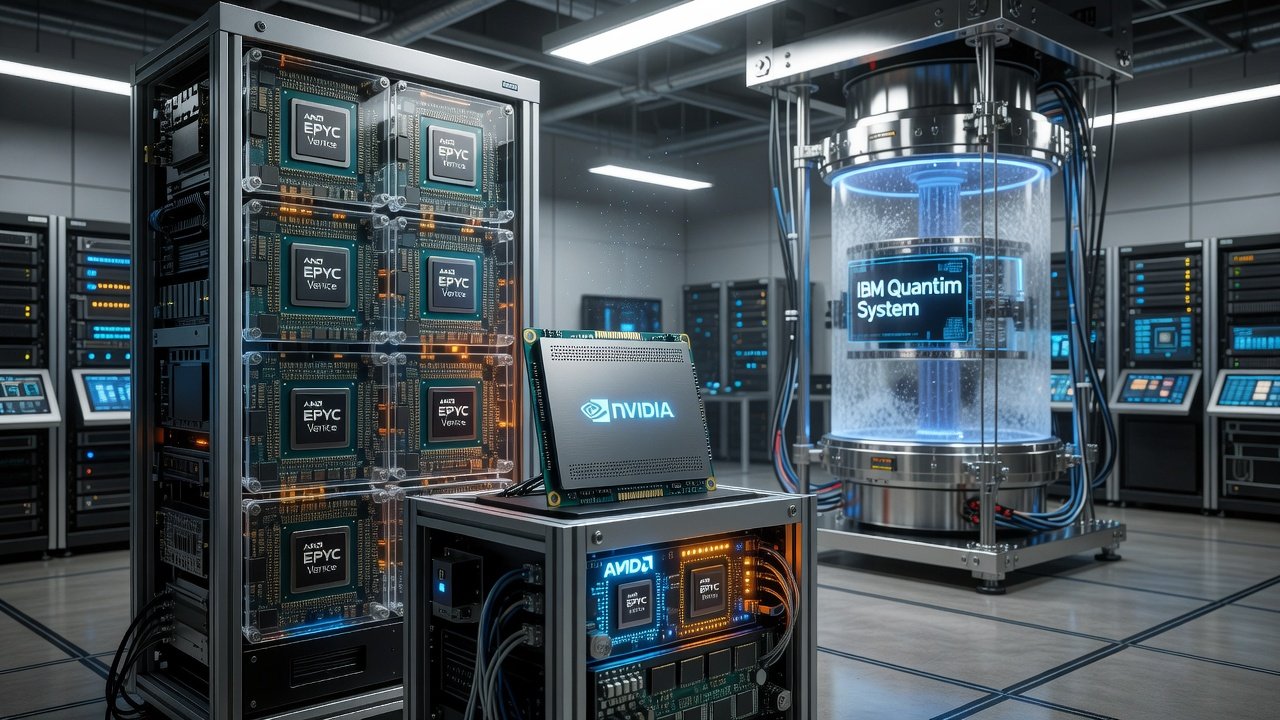
The most concrete announcement came from NVIDIA at CES 2026. The company unveiled the Jetson T4000, a new edge AI platform that boasts a staggering 1200 TFLOPS of processing power. Built on NVIDIA’s latest architecture, the Jetson T4000 is designed to handle complex AI workloads in real-time, making it a game-changer for robotics and autonomous systems.
With this new platform, developers can create applications that require real-time processing, such as autonomous vehicles, drones, and smart cameras. The Jetson T4000 is set to redefine the capabilities of edge devices, allowing them to perform tasks that were previously only possible in the cloud.
# AMD’s 2nm EPYC Venice: A New Era for Data Centers
AMD also made headlines with the announcement of its new EPYC Venice processors, built on a cutting-edge 2nm process. These processors promise to deliver unprecedented performance and efficiency for data centers, enabling organizations to run AI workloads more effectively.
The EPYC Venice processors are designed to support the growing demand for AI and machine learning applications, providing the necessary power to handle large datasets and complex algorithms. This advancement is crucial as businesses increasingly rely on AI to drive innovation and improve operational efficiency.
# IBM’s Quantum Leap: 133-Qubit System
IBM showcased its latest quantum computing advancements with the introduction of a 133-qubit quantum system. This new system represents a significant leap in quantum computing capabilities, allowing researchers and developers to tackle problems that were previously thought to be unsolvable.
As quantum computing continues to evolve, it will play a vital role in the future of AI, enabling faster processing and more complex computations. The integration of quantum computing with AI infrastructure will open new avenues for innovation and discovery.
This week’s announcements highlight the rapid advancements in AI hardware and infrastructure. As companies like NVIDIA, AMD, and IBM push the boundaries of what is possible, the future of AI looks brighter than ever.