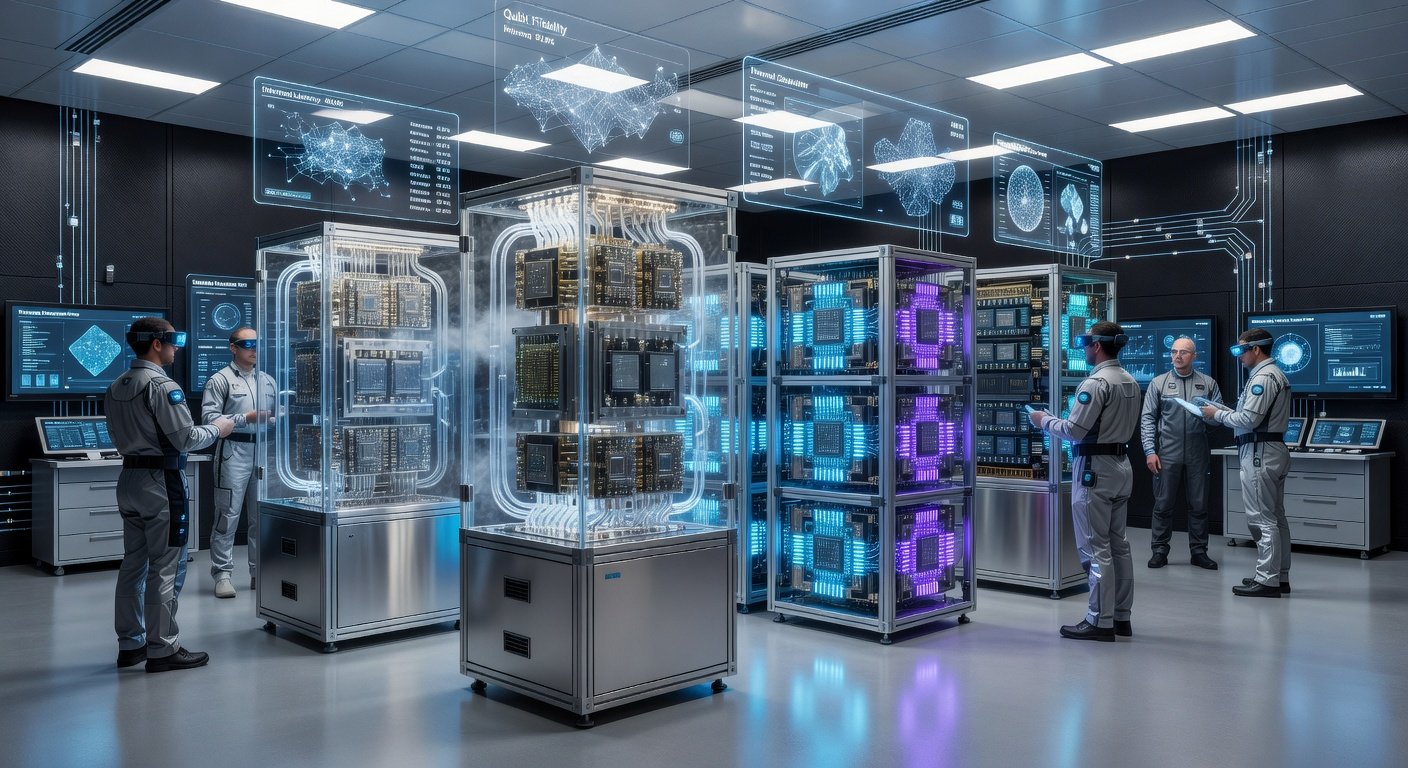
Overview of AI and quantum computing
The convergence of AI and quantum computing has long been a theoretical promise. This week, NVIDIA made it operational. Across the semiconductor landscape, Google, Cadence, Altera, and NEO Semiconductor are each making significant moves that signal a broader shift in how AI infrastructure is built, trained, and deployed. Here is what you need to know.
NVIDIA Opens the Door to AI-Powered Quantum Computing
NVIDIA has released a strong string: Ising. This first family of open-source AI models specifically designed to accelerate quantum error correction is a game-changer. The models are designed to accelerate quantum error correction by tackling its most persistent obstacles: error correction and processor calibration. According to Crescendo AI News, the models deliver 2.5x faster quantum error correction than traditional methods.
Quantum computers are inherently noisy. Quantum error correction is essential to ensure that the computations performed by quantum computers are accurate. NVIDIA’s Ising models are designed to address this challenge head-on, providing a robust framework for error correction that can be integrated into existing quantum computing architectures.
Google and the Future of Inference Chips
While NVIDIA is making strides in quantum computing, Google is focusing on inference chips. These chips are designed to optimize the performance of AI models during inference, which is the phase where models make predictions based on input data. Google’s latest inference chips are expected to significantly reduce latency and improve the efficiency of AI applications.
As AI models become more complex, the need for specialized hardware to support them becomes increasingly important. Google’s advancements in inference chip technology are a testament to the growing demand for hardware that can keep pace with the rapid evolution of AI.
The Hardware Race in AI
The race to develop the best hardware for AI applications is heating up. Companies like NVIDIA and Google are at the forefront, but they are not alone. Other players, including AMD and Intel, are also investing heavily in AI hardware development. This competition is driving innovation and pushing the boundaries of what is possible in AI.
As we look to the future, it is clear that the hardware landscape for AI is evolving rapidly. The convergence of AI and quantum computing, along with advancements in inference chip technology, is set to reshape the way we think about and utilize AI in the coming years.