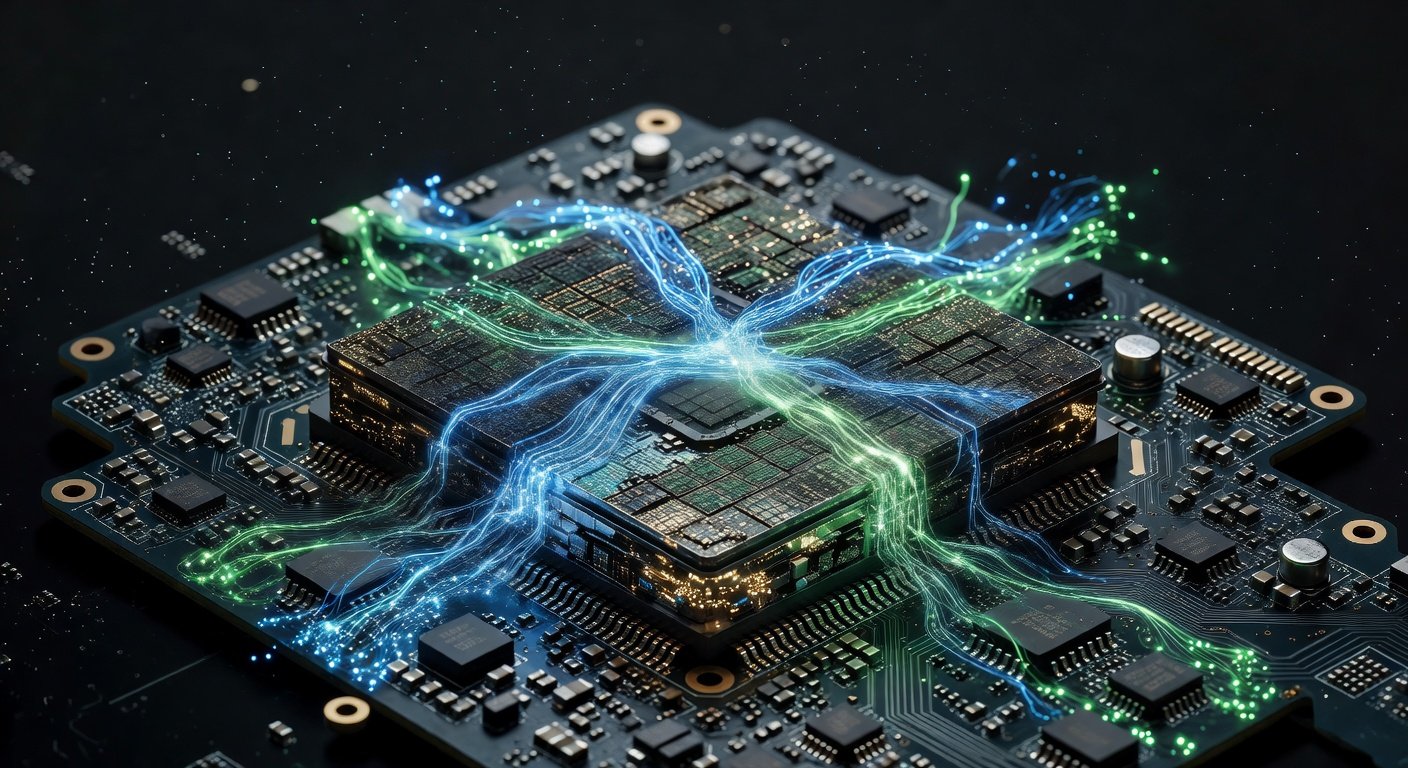
The AI computing landscape shifted notably this week on two fronts: Google Cloud unveiled its latest-generation Tensor Processing Units (TPUs), positioning itself more aggressively against NVIDIA in the AI chip market, while NVIDIA itself launched Ising—the first open-source AI models designed to accelerate quantum computing. Together, these developments demonstrate how rapidly the foundational infrastructure of AI is being rebuilt from the silicon up.
Google Cloud TPUs: A Direct Challenge to NVIDIA Dominance
According to reporting by Bloomberg Tech and TechCrunch, Google Cloud’s newest TPUs are engineered to deliver faster and more energy-efficient AI computing services—a clear strategic move to reduce enterprise dependence on NVIDIA’s GPU ecosystem. The announcement also included new partnerships aimed at expanding the TPU’s reach across cloud AI workloads.
Google’s TPUs have always been purpose-built for machine learning tasks, but this generation signals a more deliberate commercial push. Where previous iterations were largely used internally to train Google’s own models, the latest TPUs are being positioned as a competitive cloud computing product for external AI practitioners and enterprises.
- Target use case: Large-scale AI model training and inference on Google Cloud infrastructure
- Strategic intent: New partnerships announced alongside the hardware to accelerate adoption
- Competitive context: Directly targets NVIDIA’s dominance in AI accelerator hardware
For AI teams and startup founders evaluating cloud infrastructure, this matters. A credible alternative to NVIDIA-backed GPU clusters could meaningfully affect pricing, availability, and vendor lock-in decisions over the next 12 to 24 months.
NVIDIA’s Ising Models: Where AI Meets Quantum Computing
While Google targets NVIDIA’s cloud hardware position, NVIDIA itself is expanding into entirely new territory. The company released Ising—described as the first open-source AI models built specifically to accelerate quantum computing. According to NVIDIA, Ising improves quantum error correction by up to 2.5x faster convergence and achieves 3x greater accuracy in processor calibration compared to prior approaches.
The models have already been adopted by leading research institutions, including Harvard University and Fermilab, signaling that the scientific community views this as a significant and practical advance—not a theoretical one.
Quantum computing’s core challenge has always been error rates. Qubits are fragile; noise and decoherence corrupt calculations rapidly. AI-driven error correction represents a meaningful bridge between today’s noisy intermediate-scale quantum (NISQ) devices and the fault-tolerant quantum computers researchers are working toward. Ising’s open-source release also enables the broader research community to build on and validate these methods independently.
- Error correction improvement: Up to 2.5x faster with Ising models
- Calibration accuracy: 3x more precise processor calibration
- Early adopters: Harvard and Fermilab quantum computing labs
- Access model: Open-source, enabling community-driven development
Industry Implications: Infrastructure Competition Is Accelerating
These two announcements, arriving nearly simultaneously, reflect a broader dynamic in the AI sector: the competition for AI infrastructure supremacy is intensifying at every layer of the stack—from cloud services and custom silicon to foundational software models.
For cloud computing buyers, Google’s TPU push introduces meaningful optionality. Enterprises that have standardized on NVIDIA-based GPU instances now have a stronger reason to evaluate TPU-based alternatives, particularly for training workloads where cost efficiency is critical at scale.
For AI researchers and quantum computing labs, NVIDIA’s Ising release is notable because it democratizes access to advanced error-correction tooling. Historically, such capabilities required proprietary systems or deep in-house expertise. Open-source availability lowers that barrier substantially.
The convergence of AI and quantum computing also has longer-term implications for fields like drug discovery, materials science, cryptography, and financial modeling—areas where quantum advantage, once achievable, would be transformative. AI-assisted error correction is one of the clearest near-term paths toward making that advantage real.
What to Watch Next
Several developments are worth tracking closely in the weeks ahead:
- Google Cloud TPU adoption metrics: Watch for enterprise case studies and pricing disclosures that will reveal how competitive the new TPUs are in practice against NVIDIA H100 and Blackwell GPU instances.
- Ising model benchmarks from independent labs: Harvard and Fermilab’s published results using Ising will provide peer-reviewed validation of NVIDIA’s performance claims.
- Competitive responses: AMD, Intel, and cloud-native chip startups like Cerebras and Groq will likely respond to Google’s TPU announcement with positioning of their own.
- Quantum-AI convergence roadmaps: Expect more AI labs to announce quantum error-correction research programs, particularly as open-source tooling like Ising lowers the entry barrier.
The core takeaway from this week’s announcements is straightforward: AI infrastructure is no longer a single-vendor story. Google’s TPU push and NVIDIA’s quantum AI expansion both demonstrate that the most consequential competition in technology right now is happening at the hardware and systems level—and the outcomes will