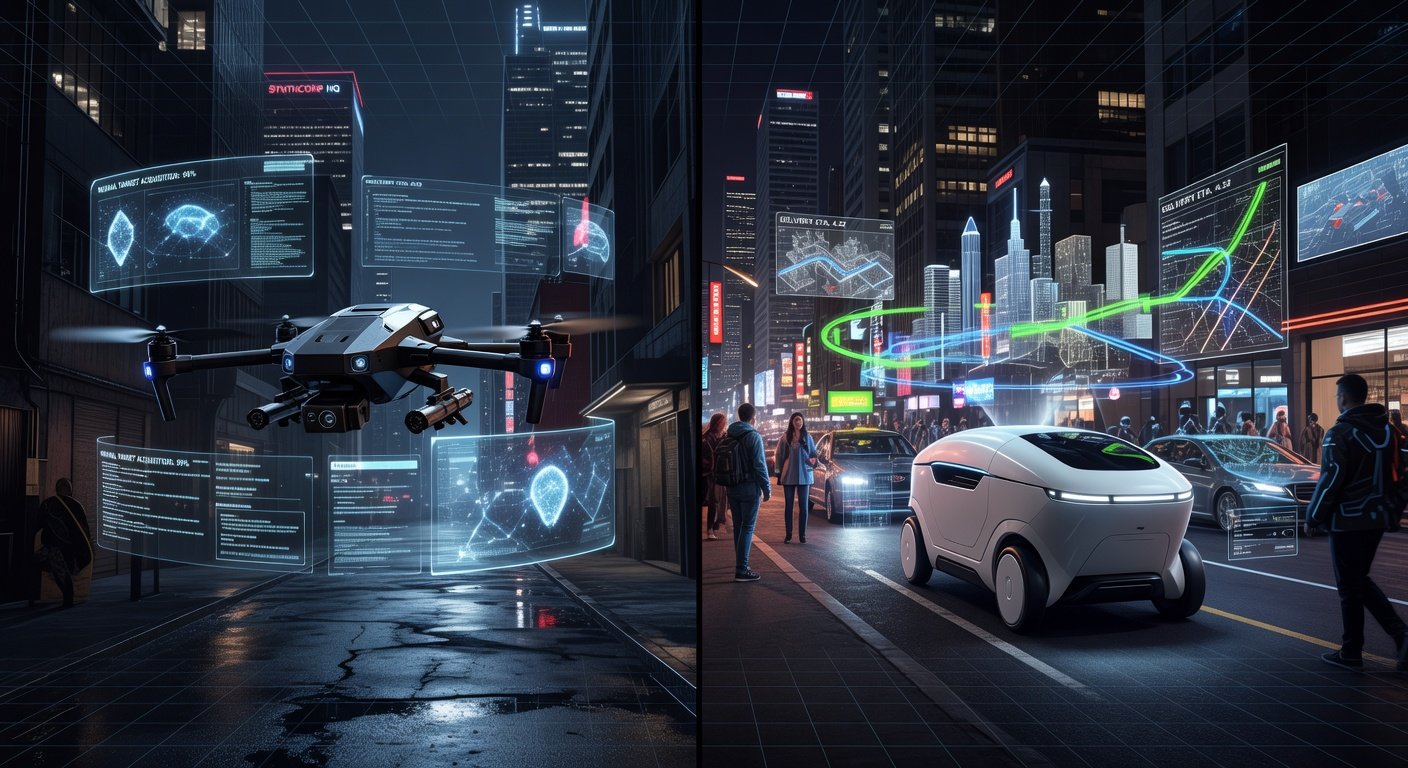
Two developments from this week signal where AI investment and innovation are concentrating: the defense sector and physical-world robotics. Together, they represent billions of dollars and decades of data being redirected toward machines that operate in the real world.
Anduril’s Reported $20B US Army Contract Marks a Defense AI Milestone
Anduril Industries has reportedly secured a $20 billion contract with the US Army, according to sources cited in a March 23 report. If confirmed at that scale, it would rank among the largest defense AI awards in history and signals a decisive shift in how the US military is approaching autonomous systems procurement.
Anduril, founded in 2017 by Palmer Luckey, has positioned itself as a software-first defense contractor. Its Lattice platform integrates sensor fusion, autonomous decision-making, and command-and-control capabilities across air, land, and sea domains. A contract of this magnitude demonstrates that the Pentagon is moving beyond pilot programs and committing to AI-native defense infrastructure at scale.
- Reported contract value: $20 billion
- Contracting party: US Army
- Core capability: AI-powered autonomous systems via the Lattice OS platform
The implications extend beyond Anduril. This signals growing institutional confidence in AI systems for mission-critical applications — and is likely to accelerate procurement timelines across competing defense contractors.
Niantic Turns a Decade of Pokémon Go Data Into Robot Navigation Intelligence
On March 22, Niantic announced it is using 10 years of Pokémon Go geospatial data to train AI-powered delivery robots for urban navigation. The collaboration with KCO leverages the 3D spatial models built from millions of players mapping real-world environments through gameplay.
This is a notably efficient approach to a hard problem. Urban navigation for autonomous robots requires extraordinarily rich environmental data — precise geometry, pedestrian patterns, infrastructure details. Niantic’s dataset, accumulated passively through consumer engagement, provides exactly that at a scale that would cost hundreds of millions of dollars to replicate through dedicated mapping efforts.
According to Niantic, the dataset spans diverse urban environments globally, enabling robots to generalize navigation across cities rather than requiring location-specific retraining. The result is a foundation model for physical-world movement that is grounded in real human behavior at street level.
- Data source: 10 years of Pokémon Go player interactions
- Application: Urban delivery robot navigation via 3D environmental models
- Partner: KCO robotics
The White House AI Framework Adds Policy Context
On March 20, the White House unveiled a new AI framework for Congress, addressing national concerns around AI safety, deployment standards, and federal oversight. While the document’s full provisions are still being analyzed, its release this week provides important regulatory backdrop for both the defense contract and commercial robotics developments.
Policy frameworks of this kind typically take 12 to 24 months to translate into enforceable standards. However, their existence shapes procurement requirements and corporate compliance roadmaps now. Defense contractors like Anduril and commercial robotics firms will both need to demonstrate alignment with emerging federal AI standards to maintain or win government-adjacent contracts.
What This Week Tells Us About AI’s Near-Term Trajectory
The convergence of these three developments — a landmark defense contract, a consumer-data-to-robotics pipeline, and a federal policy framework — reflects a maturing AI landscape. The technology is moving from research environments into physical deployment at scale, with government institutions playing a central role in both funding and governance.
The most significant forward-looking signal: proprietary data assets are becoming primary competitive moats. Niantic’s decade of geospatial data is not replicable quickly. Similarly, Anduril’s operational data from deployed systems will compound over time. Organizations that have been systematically collecting high-quality real-world data are now positioned to translate that into durable AI advantages in robotics, defense, and autonomous systems.
The race is no longer just about model architecture. It is about who owns the data that grounds AI in the physical world.