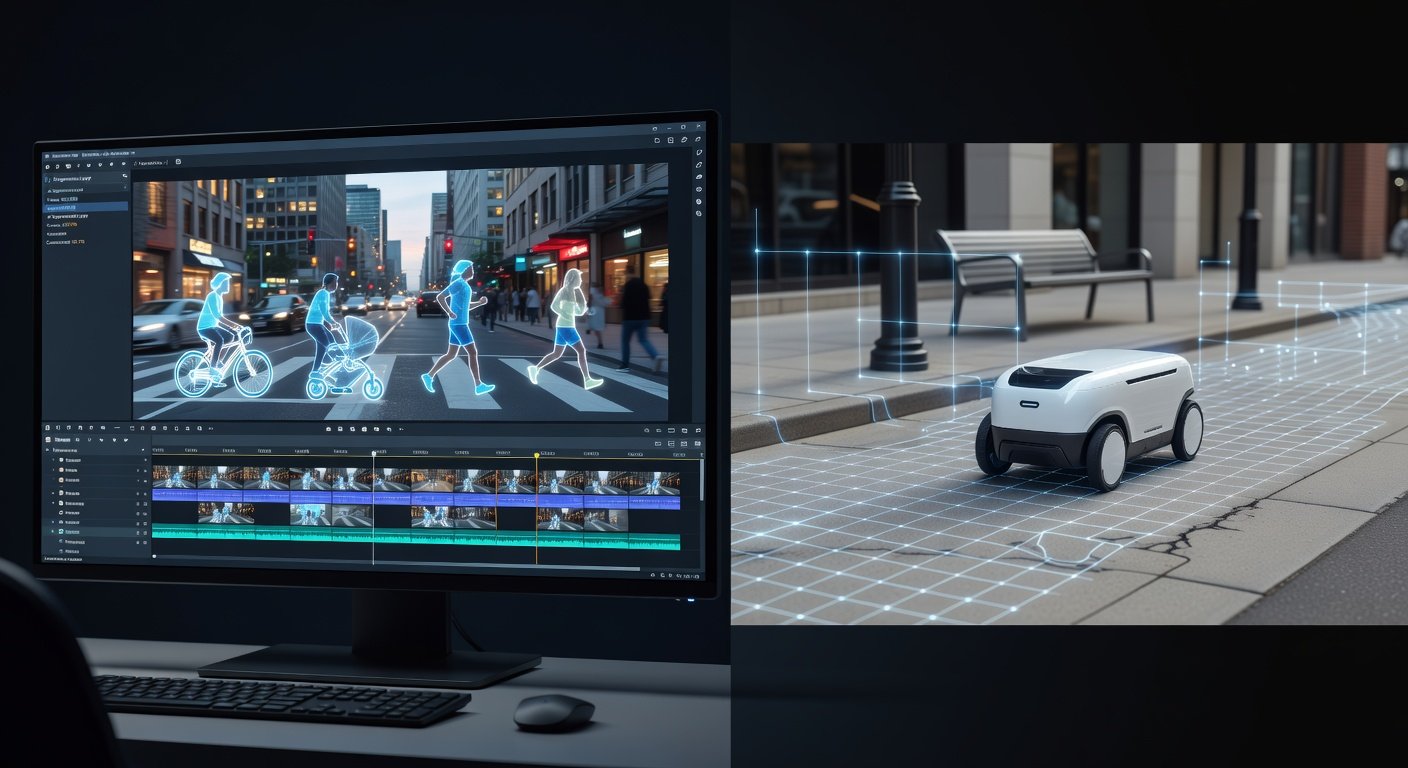
Two significant developments this week demonstrate how AI is collapsing the gap between creative production and real-world automation — one inside the VFX pipeline, the other on city streets.
ONYX Ai Matte 2.5 Eliminates Hours of Manual Roto Work
VFX artist Evgeniy Shatskiy released ONYX Ai Matte 2.5 on March 24, 2026, a GPU-accelerated plugin that enables artists to generate production-quality mattes for up to 64 moving objects simultaneously in video footage. According to CG Channel, the tool integrates Meta’s SAM 3 and VitMatte models under the hood, allowing users to isolate subjects via marquee selections, guide points, or plain-language text prompts such as ‘person’ or ‘car’.
The practical impact is substantial. Rotoscoping — the frame-by-frame process of manually tracing objects to create masks — has historically consumed days of artist time on even modest productions. ONYX Ai Matte 2.5 targets that bottleneck directly. The ability to use natural language prompts notably lowers the technical barrier, meaning editors and compositors without deep roto experience can now produce accurate mattes at speed.
- Supports up to 64 moving objects per video sequence
- Text prompt input removes the need for frame-by-frame manual selection
- GPU-accelerated processing keeps render times competitive with professional workflows
- Built on Meta SAM 3 and VitMatte — two of the most capable open segmentation models available
For studios managing high-volume content — streaming series, advertising, or real-time broadcast graphics — tools like this transforms the economics of visual effects production.
Niantic Turns a Decade of Pokémon Go Data into Robot Navigation Intelligence
On March 22, 2026, Niantic Spatial announced a partnership with robotics startup KCO to train 3D spatial AI models using anonymized location and mapping data collected over ten years of Pokémon Go gameplay. The goal: enable next-generation delivery robots to navigate complex urban environments more reliably.
The scale of the underlying dataset is what makes this notable. Pokémon Go has been played in virtually every major city on Earth, generating dense, real-world spatial data across diverse street layouts, pedestrian patterns, and environmental conditions. According to reports, Niantic Spatial is applying that accumulated geographic intelligence to help robots understand and move through the same environments where players once hunted virtual creatures.
This approach — repurposing consumer-generated data for industrial AI training — demonstrates a broader trend: the most valuable training sets are not always purpose-built. Decade-scale behavioral data from mass-market applications can carry significant signal for entirely different domains.
Industry Implications: Convergence of Creative and Physical AI
Taken together, these two stories point toward a consistent pattern in applied AI development. Foundation models trained for one purpose are being adapted rapidly for adjacent use cases — Meta’s segmentation models now power professional VFX tools; consumer mapping data now trains autonomous robots.
For AI practitioners and startup founders, the signal is clear: proprietary datasets accumulated over years of user interaction represent durable competitive assets. Niantic’s decade of spatial data is not easily replicated. Similarly, the integration of SAM 3 into a production VFX plugin demonstrates that open model releases from major labs create immediate downstream commercial opportunities for developers who move quickly.
The release of the documentary The AI Doc: Or How I Became an Apocaloptimist — featuring interviews with leading AI CEOs on the risks and promise of the technology — also reflects a broader cultural moment. The industry is increasingly engaging publicly with questions of consequence, not just capability.
Forward Outlook
AI-powered VFX tools are on a trajectory toward real-time, on-set application — not just post-production. As GPU performance and model efficiency improve, expect mask generation and compositing assistance to move closer to the camera rather than the edit bay. Meanwhile, the Niantic-KCO partnership signals that robotics companies willing to source training data creatively — rather than collecting it from scratch — may reach deployment-ready models significantly faster than competitors.
The takeaway: the most impactful AI applications this week are not new models — they are smart integrations of existing models into workflows where the productivity gains are immediate and measurable.