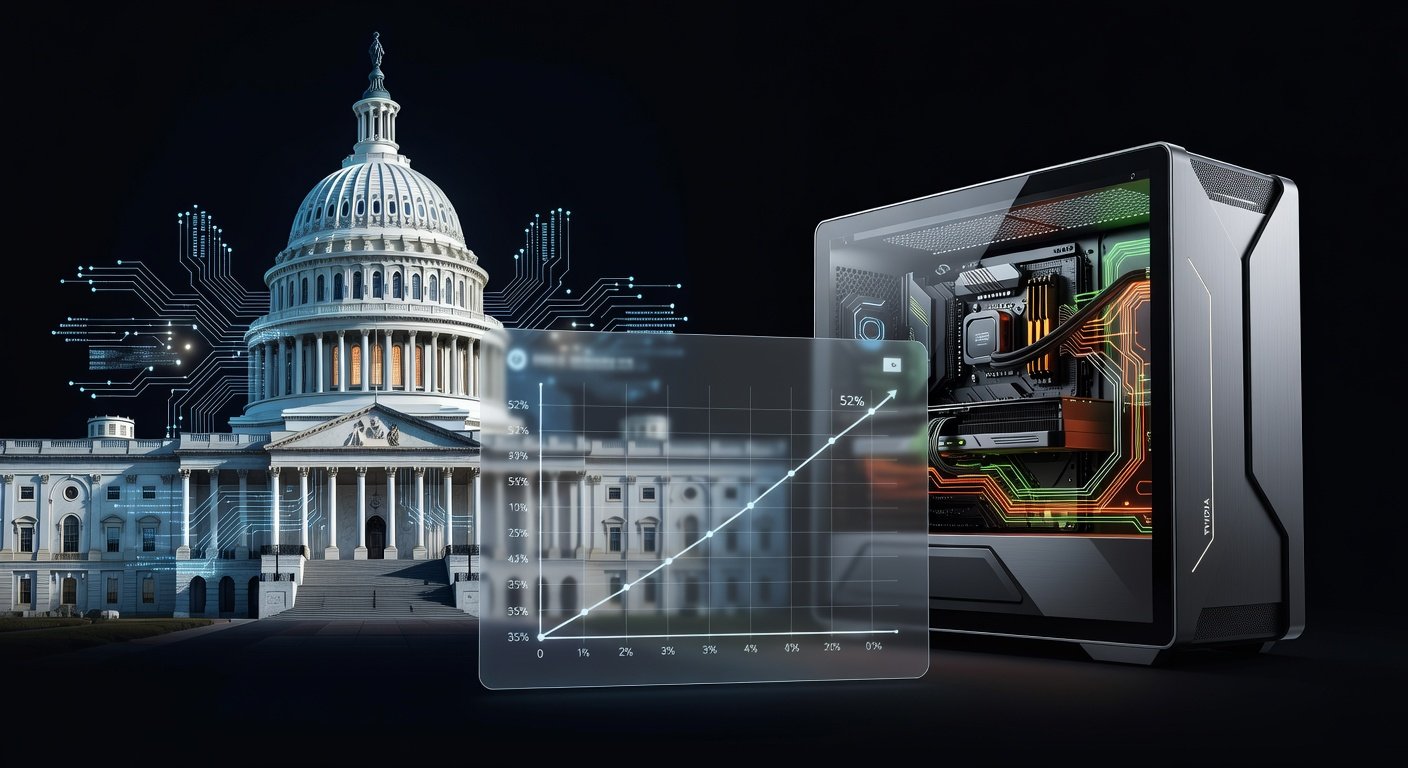
In a single week, AI policy, hardware, and model research converged in ways that signal where the industry is heading in 2026. The White House formally addressed Congress on AI strategy, Nvidia showcased desktop chips capable of 20 petaflops, and a new attention mechanism pushed AI agent task completion rates up by 17 percentage points. Each development, on its own, is significant. Together, they sketch a clear picture of an industry accelerating on every front simultaneously.
White House Lays Out AI Framework for Congress
On March 22, 2026, White House science advisor Michael Kratsios presented the Trump administration’s comprehensive AI action plan to Congress, according to Fox News. The briefing addressed one of the most politically sensitive dimensions of AI adoption: its potential impact on the labor market.
The plan represents the administration’s clearest signal yet that federal AI governance is moving from reactive commentary to structured policy. While specific legislative proposals were not detailed publicly, the engagement with Congress marks a notable shift toward formal oversight frameworks. For AI practitioners and startup founders, this matters because federal policy shapes procurement rules, liability standards, and funding priorities — all of which directly affect product roadmaps and go-to-market strategies.
The timing is deliberate. With AI agent platforms automating knowledge work at an accelerating pace, policymakers are under pressure to establish guardrails before adoption outpaces regulation.
AI Agent Platforms: A Measurable Performance Leap
The competitive landscape for AI agents is intensifying rapidly. Platforms including OpenClaw, Tencent QClaw, and MiniMax M2.7 are actively competing for enterprise adoption, and the performance gap between them is narrowing fast.
The most concrete data point this week comes from research on Attention Residuals, an architectural innovation that demonstrates a significant improvement in agent task completion rates — climbing from 35% to 52%. That 17-percentage-point gain is not incremental. It represents the difference between an agent that fails on roughly two-thirds of complex tasks and one that succeeds on more than half. For enterprise deployments where reliability is non-negotiable, this threshold matters.
At Nvidia’s GTC conference, the agent ecosystem was on full display. Frameworks from OpenClaw, Perplexity Computer, and Anthropic Dispatch were highlighted as leading contenders, each taking a distinct approach to how agents plan, execute, and recover from errors. The competition is no longer about which model is smartest in isolation — it is about which platform orchestrates tasks most reliably at scale.
New Models and the Hardware Enabling Them
The model release cadence continues to accelerate. Notable arrivals this week include:
- Mistral Small 4 — a compact model optimized for efficiency
- Google AlphaEvolve — targeting scientific and research applications
- IBM Granite 4.0 — focused on enterprise speech capabilities
- GLM OCR — advancing document understanding
- Recursive Language Models (RLM) — a new architectural approach to multi-step reasoning
Meanwhile, Claude currently leads major leaderboards with a 1-million-token context window, enabling it to process entire codebases, legal documents, or research archives in a single pass — a capability that transforms how professionals interact with large information sets.
On the hardware side, Nvidia’s GB300 desktop chip delivers 20 petaflops of AI compute. That figure, once reserved for data center infrastructure, is now available in a workstation form factor. This enables on-premise AI deployments for organizations with data sovereignty requirements, and it lowers the barrier for researchers who need serious compute without cloud dependency.
What This Means Going Forward
The convergence of federal policy attention, measurable agent performance gains, and expanding hardware availability points toward a near-term environment where AI deployment becomes both more capable and more regulated. Organizations that begin aligning their AI strategies with emerging policy frameworks now will be better positioned when compliance requirements formalize.
The agent completion rate improvement from 35% to 52% is the number to watch. As that figure continues climbing toward reliable autonomy, the use cases that become economically viable will expand significantly — and the policy conversations happening in Washington will increasingly determine the boundaries within which that expansion occurs.
The takeaway: This week confirmed that AI’s next chapter is being written simultaneously in research labs, chip fabs, and congressional briefing rooms. Staying current across all three is no longer optional for serious practitioners.