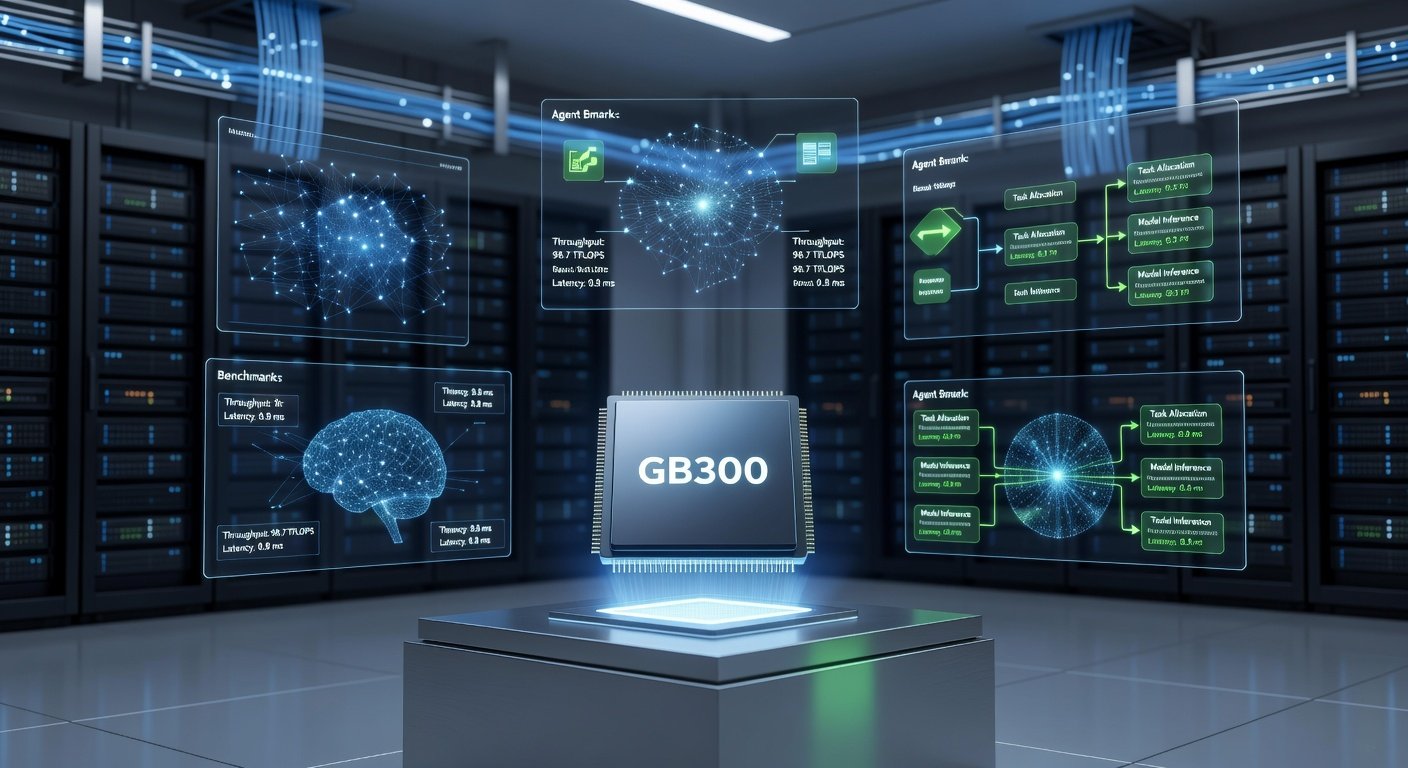
Twenty petaflops on a desktop chip. That is the headline number from Nvidia’s GTC 2026 conference, and it signals a significant shift in where serious AI compute is heading. But the hardware announcement is only part of the story. Alongside the GB300, a wave of agent platforms, lean open-source models, and architectural breakthroughs emerged this week — collectively painting a clear picture of where AI development stands in early 2026.
Nvidia GB300 and the New Hardware Baseline
The GB300 chip delivers 20 petaflops of AI performance in a desktop form factor, according to Nvidia’s GTC announcements. That figure matters because it democratizes compute capacity that was, until recently, confined to data centers. Developers and researchers who previously depended on cloud infrastructure for large-scale inference can now consider on-premise alternatives at a fraction of the operational cost.
This shift has direct implications for latency-sensitive applications — real-time agents, local model inference, and privacy-critical workloads among them. The GB300 does not replace cloud AI infrastructure, but it meaningfully expands the deployment surface for high-performance models.
AI Agent Platforms Move from Concept to Competition
The agent ecosystem is consolidating rapidly. GTC 2026 highlighted several platforms now competing for developer adoption: OpenClaw, Perplexity Computer, Meta Manus, and Anthropic Dispatch. Each targets a different segment of the agentic workflow — from autonomous coding to multi-step research tasks.
Notably, Andrej Karpathy publicly stated he now delegates all coding tasks to AI agents, a data point that reflects broader practitioner sentiment. Claude currently leads both text and coding leaderboards, supported by a 1 million token context window that enables agents to process entire codebases or lengthy document sets in a single pass.
- OpenClaw targets developer automation and multi-agent orchestration
- Anthropic Dispatch focuses on structured task delegation within Claude’s ecosystem
- Perplexity Computer integrates search-grounded reasoning into agentic workflows
- Meta Manus extends Meta’s open-model strategy into agent-native applications
The competition is no longer about which model scores highest on a benchmark. It is about which platform makes agents reliable and composable enough for production use.
Open-Source Models Close the Gap — at Significantly Lower Cost
Chinese open-source releases are performing at benchmark levels that rival proprietary systems, according to the GTC coverage. GLM OCR, Tencent QClaw, MiniMax M2.7, and MaxClaw all demonstrated high scores while maintaining cost structures that make them attractive alternatives for cost-sensitive deployments.
This matters for the broader AI industry. When capable open-source models are available at low cost, the competitive moat for proprietary providers narrows to factors like safety, reliability, enterprise support, and ecosystem integration — not raw capability alone. Mistral Small 4 and Google AlphaEvolve also debuted at GTC, adding further density to an already crowded model landscape.
IBM’s Granite 4.0 release adds a compact multilingual speech model to the mix, demonstrating that efficiency-focused, domain-specific models continue to find strong use cases alongside general-purpose large language models.
Attention Residuals Demonstrate a 35-52% Performance Gain
Perhaps the most technically significant development from this week is the attention residuals architecture, which reportedly boosts agent performance by 35 to 52 percent while requiring less compute, according to GTC session coverage. Combined with advances in recursive language models, this architectural direction suggests that raw parameter scaling is no longer the primary path to performance gains.
Efficiency-first architectures are increasingly where research energy is concentrating. For practitioners building on top of foundation models, this means future model updates may deliver meaningful capability improvements without proportional increases in inference cost.
The week’s announcements, taken together, indicate that AI in 2026 is defined less by individual model releases and more by the infrastructure, agent frameworks, and architectural innovations that determine how those models perform in real-world conditions. Teams that invest now in understanding agentic deployment and efficient inference architectures will be better positioned as these capabilities become standard expectations rather than differentiators.