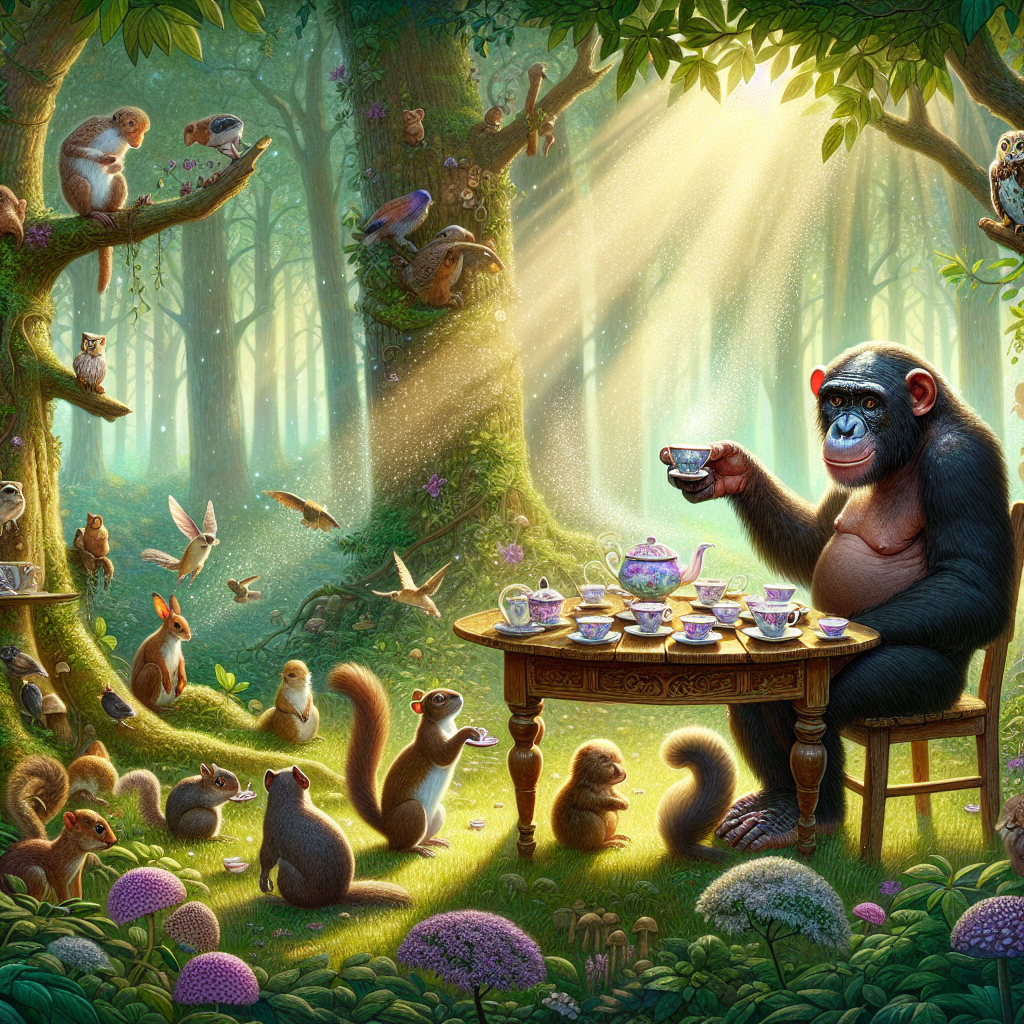
# An Ape, a Tea Party — and the Ability to Imagine
In a groundbreaking study published in *Science* on February 5, 2026, researchers demonstrated that a bonobo named Kanzi could engage in pretend play during a simulated tea party, challenging the long-held belief that imagination is uniquely human.[1][2] By tracking invisible juice and imaginary grapes, Kanzi showed he could distinguish between real and make-believe scenarios, prompting scientists to rethink the cognitive boundaries between apes and humans.[2][3]
## Kanzi: The Bonobo Who Defied Expectations
Kanzi, a bonobo who lived until March 2025 at age 44, was no ordinary ape. Raised in a human environment from birth, he mastered lexigrams—graphic symbols linked to words—for communication, combining them creatively to express novel ideas.[1][2] He even crafted simple stone tools, a skill rare among his species. This unique upbringing made him an ideal subject for probing deeper questions about animal minds.
The study, led by Amalia Bastos of the University of St Andrews and Christopher Krupenye of Johns Hopkins University, built on observations from Bastos’s first meeting with Kanzi in 2023. During that encounter, Kanzi used his lexigram board to request that researchers pretend-chase each other, delighting in the make-believe action despite its unreality.[2] This sparked formal experiments to test whether apes possess **pretend play**—the ability to act as if something exists while knowing it does not, a hallmark of human development that emerges around age two.[1]
Pretend play differs sharply from imitation or error. Young children transform a cardboard box into a spaceship or an empty cup into “tea,” sustaining shared imaginary worlds through mutual agreement.[1] For years, this was seen as tied exclusively to human language, culture, and creativity. Chimps and bonobos, though clever, were thought incapable of holding dual realities: the actual and the imagined.[2]
## The Pretend Tea Party Experiment Unfolds
Researchers adapted child psychology tests for Kanzi, staging a **make-believe juice party**. An experimenter mimed pouring juice from an empty, transparent jug into two cups, then “emptied” one back into the jug. Asked which cup held the “juice,” Kanzi pointed correctly to the pretend-full one about **68% of the time**—far above chance.[1][2]
Skeptics might argue Kanzi mistook mime for reality, perhaps due to age-related vision issues. To counter this, the team ran a control: one cup with real orange juice (Kanzi’s favorite) and one with pretend juice. He selected the real juice nearly **80% of the time**, proving he distinguished authentic rewards from fiction.[1][2] A parallel test with fake grapes yielded similar results, reinforcing Kanzi’s grasp of invisible contents.[2]
Bastos emphasized the rigor: “That suggests that he really can tell the difference between real juice and imaginary juice.”[1] Krupenye added, “What’s really exciting about this work is that it suggests that the roots of this capacity for imagination are not unique to our species.”[1][3]
## Challenging Assumptions About Imagination
These findings upend decades of assumptions. Imagination—mentally simulating absent scenarios—underpins human innovation, from inventing bicycles to planning futures.[2] Apes’ tool use was often chalked up to trial-and-error, but if they imagine first, it reframes their ingenuity. As cognitive scientist Cathal O’Madagain noted, “You can’t invent a bicycle if you can’t imagine one first.”[2]
Not all experts agree. Duke’s Michael Tomasello, uninvolved in the study, argues that responding to experimenter-created pretense falls short of Kanzi *generating* it himself, as human children do.[1] Kanzi’s human-immersed life also raises questions of generalizability—he wasn’t a “typical” bonobo.[1][2]
Still, the evidence is compelling. Human toddlers master pretend worlds by age three, enabling complex social cognition.[2] Kanzi’s success hints at evolutionary precursors in our primate lineage, blurring species lines.[3]
## Broader Implications for Animal Minds and Conservation
This research opens doors to future studies. Bastos plans to test apes without Kanzi’s enriched background, potentially confirming imagination’s wider presence.[1][2] For endangered species like bonobos, understanding their mental lives could inform conservation, revealing depths beyond survival instincts.[1]
Kanzi’s legacy endures. As one of the last human-raised apes of his era, he “opened this path for a lot of future studies,” per Bastos.[1] His imaginary tea party reminds us: intelligence isn’t a human monopoly. It thrives in shared capacities, urging humility in how we define minds.
In 2026, as AI voices narrate such discoveries and ethical debates swirl, Kanzi’s story underscores a timeless truth—an ape at a tea party proves imagination’s spark ignites early in evolution, inviting us to imagine anew.[2]
*(Word count: 812)*
Original source: NPR News – An ape, a tea party — and the ability to imagine