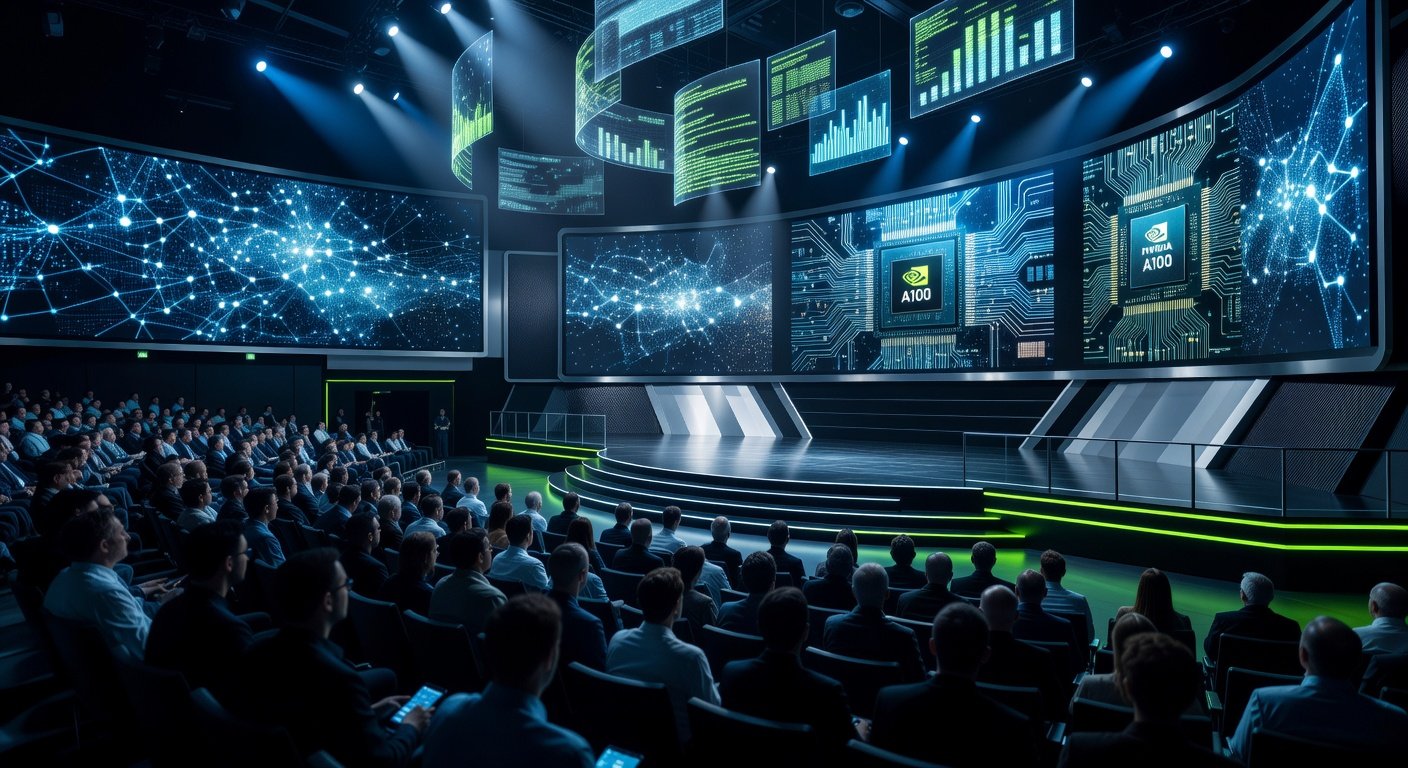
The week of March 16, 2026 may be remembered as the moment the AI stack snapped into focus. NVIDIA’s GTC conference opened in San Jose with a sweeping showcase of physical AI, agentic systems, and next-generation inference infrastructure — while, almost simultaneously, the broader ecosystem delivered advances in foundation models, open-source tooling, robotics, and on-device hardware that collectively signal a significant maturation of the field.
This is not a single breakthrough. It is a coordinated convergence — and the implications for AI practitioners, enterprise builders, and researchers are substantial.
NVIDIA GTC 2026: Physical AI and the Infrastructure Layer
NVIDIA’s GTC 2026 centered on four pillars: physical AI, agentic AI, optimized inference, and AI factory scaling. The announcements align directly with the company’s recently unveiled Vera Rubin platform and H300 GPUs, positioning NVIDIA not just as a chip supplier but as the foundational infrastructure layer for the next generation of AI deployment.
Physical AI — systems that perceive and act in the real world — emerged as a defining theme. This connects directly to parallel developments in robotics: Hyundai detailed its AI and robotics roadmap at CES 2026, revealing a modular platform for logistics and human assistance built on large language models and generative AI, with enhanced autonomy developed in collaboration with Boston Dynamics. The integration of LLMs into mobile robots for natural human interaction marks a notable step beyond scripted automation.
Meanwhile, AMD entered the on-device AI conversation with its Ryzen AI 400 Series, bringing dedicated neural processing units (NPUs) to consumer laptops. The move enables local AI acceleration without cloud dependency — a meaningful shift for enterprise privacy requirements and latency-sensitive applications.
Foundation Models Hit New Benchmarks — and Fewer Hallucinations
The model layer delivered equally significant data points this week. Gemini 3.1 Pro doubled its ARC-AGI-2 logic scores to 77.1% and reached 94.3% on GPQA Diamond, a benchmark measuring expert-level scientific knowledge. These are not incremental gains — they represent a meaningful leap in reasoning capability for complex, multi-step problems.
GPT-5 demonstrated a 45% reduction in hallucinations with web search enabled, climbing to 80% accuracy reduction under extended thinking mode. For enterprise deployments where reliability is non-negotiable, this trajectory matters. Claude Opus 4.6 contributes a complementary capability: improved recognition of impossible or contradictory tasks, choosing confident refusal over confabulation — a critical behavior for agentic systems operating with limited human oversight.
Perhaps the most quietly significant result came from Google DeepMind’s AlphaEvolve, which discovered new mathematical structures in complexity theory and, as a direct byproduct, recovered 0.7% of Google’s compute resources. At Google’s scale, that fraction represents enormous real-world value — and demonstrates that AI-assisted mathematical research is now producing measurable infrastructure returns.
Open-Source Momentum: Perplexity and Alibaba Raise the Bar
The open-source layer is increasingly competitive with proprietary offerings. Perplexity released two embedding models that rival Google and Alibaba on multilingual retrieval accuracy, using bidirectional reading and diffusion training with quantization to reduce memory requirements. For teams building AI search or retrieval-augmented generation pipelines, accessible, high-performance embeddings lower a significant barrier.
Alibaba’s Qwen3.5 compact models introduce hybrid linear attention and mixture-of-experts (MoE) architecture to deliver strong reasoning and multimodal performance on laptops and edge hardware. The ability to run capable models locally — without cloud compute costs — enables a new class of applications in regulated industries, emerging markets, and resource-constrained environments.
- Perplexity embeddings: Open-source, multilingual, memory-efficient via quantization
- Qwen3.5: Hybrid MoE architecture optimized for edge and laptop deployment
- MIT protein AI: Generative model predicting synthetic protein folding, targeting cancer, autoimmune, and rare disease R&D cost reduction
MIT’s generative AI model for protein-based drug design rounds out the week’s open research highlights. By predicting synthetic protein folding and biological target interactions, the model addresses one of pharmaceutical R&D’s most expensive bottlenecks — with potential to accelerate treatments across oncology, autoimmune conditions, and rare genetic disorders.
What to Watch: The Stack Is Converging
The pattern emerging across these announcements is structural. The AI stack — infrastructure, models, tooling, and edge hardware — is consolidating around a set of clear architectural choices: agentic systems built on reliable, hallucination-resistant models; physical AI grounded in purpose-built robotics platforms; and inference optimized for both cloud-scale factories and on-device NPUs.
For practitioners, the near-term priorities are clear: evaluate the new embedding models for retrieval pipelines, monitor agentic reliability benchmarks as GPT-5 and Claude Opus 4.6 mature, and track how NVIDIA’s Vera Rubin platform shapes enterprise AI factory procurement through 2026.
The forward-looking takeaway: the competitive advantage in AI is shifting from model access to deployment architecture. Organizations that understand how to assemble and optimize the full stack — from NPU-equipped edge devices to cloud-scale inference clusters — will move faster than those optimizing any single layer in isolation.