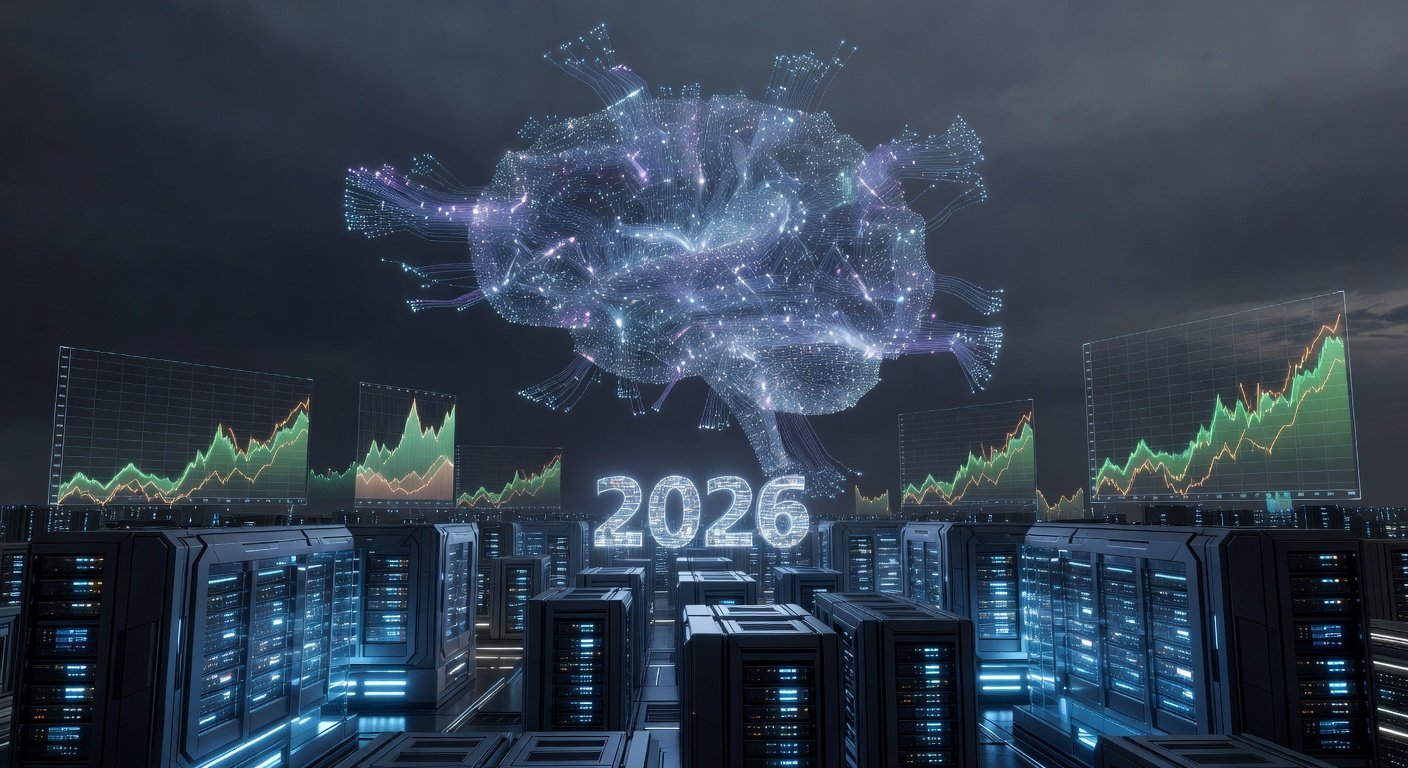
What if the most transformative moment in human history is less than 18 months away? That’s not science fiction — that’s the warning coming straight from one of Wall Street’s most respected institutions. Morgan Stanley is sounding the alarm on a massive AI breakthrough expected in the first half of 2026, and the data behind the prediction is difficult to ignore.
The 2026 AI Breakthrough: What Morgan Stanley Is Predicting
Morgan Stanley’s latest analysis points to an unprecedented convergence of compute power, model intelligence, and infrastructure investment that could fundamentally reshape the global economy. At the center of this prediction is a simple but staggering principle: AI labs are scaling compute by 10x, which is expected to double model intelligence — a claim echoed by Elon Musk and corroborated by rapid benchmark progress across leading AI systems.
The report highlights that progress is already outpacing expectations, with executives at top AI labs privately warning that the speed of advancement is shocking even to insiders. If the trajectory holds, Morgan Stanley believes a transformative leap in AI capability could arrive as early as the first half of 2026, with the potential for recursive self-improvement emerging by 2027 — a milestone that would mark a point of no return for the technology’s development.
GPT-5.4 and the New Benchmark Reality
The numbers are already telling a compelling story. OpenAI’s GPT-5.4 ‘Thinking’ model has achieved 83.0% on the GDPVal benchmark — a rigorous evaluation designed to measure performance on economically valuable, real-world tasks. Crucially, this score matches or exceeds human expert-level performance on the same tasks.
This isn’t just an academic milestone. The GDPVal benchmark was specifically designed to reflect tasks that drive economic output — the kind of work done by analysts, lawyers, engineers, and researchers. An AI system performing at this level signals that white-collar cognitive labor is now directly in the crosshairs of automation, a shift with profound implications for businesses and workers alike.
The Infrastructure Arms Race Powering the Breakthrough
Behind every AI breakthrough is a power grid, and the race to build one is accelerating at a pace few anticipated. Morgan Stanley’s report introduces the emerging ’15-15-15′ economics framework reshaping AI infrastructure investment:
- 15-year data center leases locking in long-term AI infrastructure commitments
- 15% yields making AI data centers among the most attractive real estate investments globally
- $15 per watt value driving creative energy solutions across the industry
To meet the insatiable energy demands of next-generation AI training runs, developers are repurposing Bitcoin mining facilities and deploying gas turbines for rapid, scalable power generation. This infrastructure pivot signals that the AI compute race has moved well beyond Silicon Valley server rooms and into the realm of national energy strategy.
Industry Implications and the Future Outlook
The deflationary impact of AI on labor markets is no longer a distant concern — it is an active trend. Morgan Stanley’s analysis explicitly flags job displacement as a near-term consequence of the coming AI wave, particularly in knowledge-intensive sectors. Companies that fail to adapt their workforce strategies risk being caught flat-footed when the breakthrough arrives.
On a geopolitical level, AI’s role is already expanding. The trending use of U.S. AI systems in high-stakes military and strategic contexts — including reported applications in the Iran conflict — underscores that this technology is no longer purely commercial. The race for AI supremacy is now inseparable from national security.
For investors, the implications are equally significant. The ’15-15-15′ economics suggest that AI infrastructure is becoming an asset class in its own right, with long-duration, high-yield characteristics that rival traditional real estate and energy investments.
Conclusion: The Clock Is Ticking
Morgan Stanley’s warning is not alarmist — it is analytical. With GPT-5.4 already matching human experts, compute scaling accelerating at a 10x pace, and billions pouring into AI infrastructure, the conditions for a historic breakthrough are being assembled in real time. The question is no longer whether a transformative AI leap is coming, but whether individuals, businesses, and governments will be ready when it arrives. Start preparing now — 2026 may be closer than it feels.