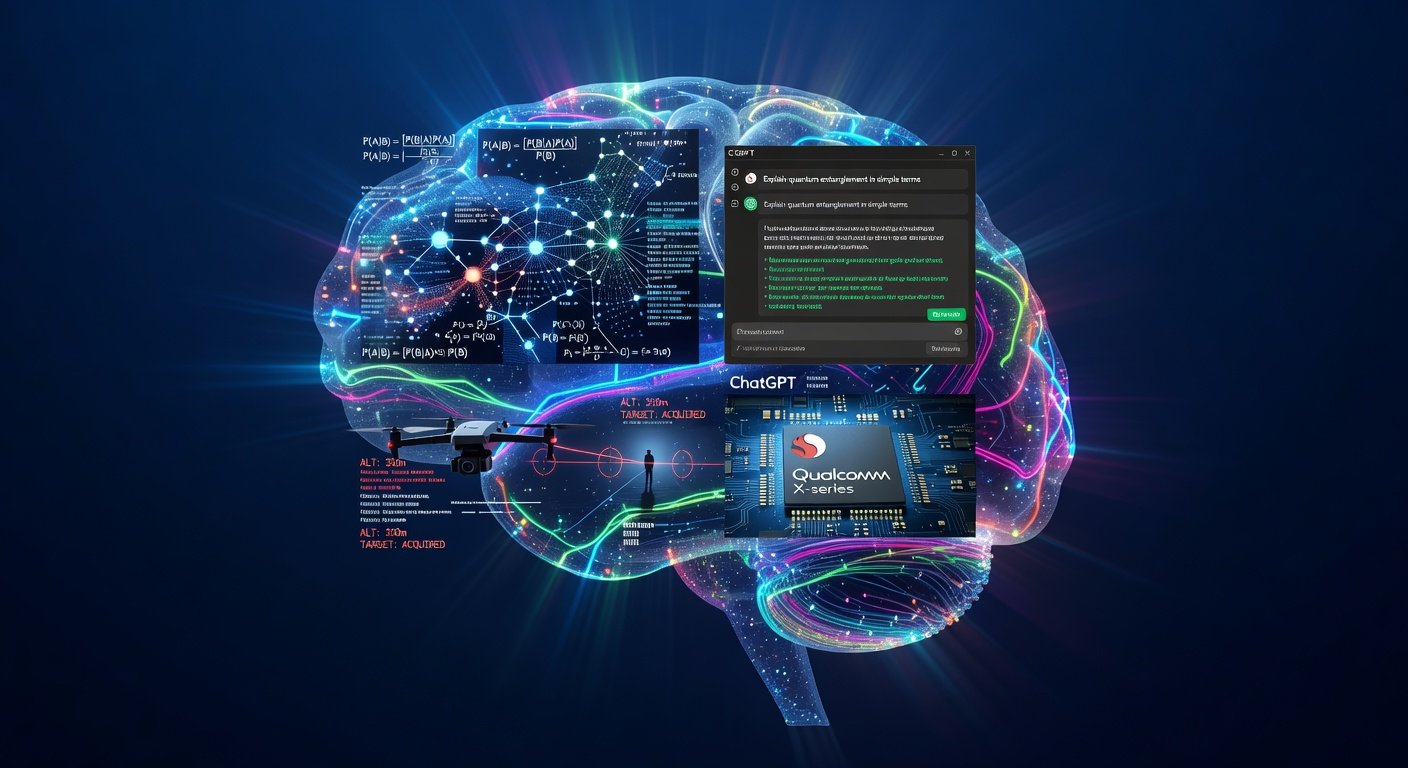
Artificial intelligence is no longer just evolving — it is rewriting the rules of how machines think, learn, and act. In a single week in early March 2026, we witnessed a landmark training breakthrough from Google, a powerful new model release from OpenAI, and a sobering reminder that AI has firmly entered the theater of modern warfare. Here is what you need to know.
Google’s Bayesian Teaching: LLMs That Actually Learn From You
The most technically significant development of the week came from Google researchers, who unveiled a novel training approach called Bayesian teaching. Unlike traditional large language models that treat each conversation as a blank slate, Bayesian teaching enables LLMs to dynamically update their beliefs and predictions based on new evidence introduced across multiple interactions.
In practical terms, this means a model trained with this technique can revise its confidence in an answer when you provide contradicting data — much like a human expert would. The results are striking: models trained with Bayesian teaching achieved approximately 80% accuracy when benchmarked against an ideal Bayesian assistant, a significant leap over conventional approaches.
- Problem solved: Standard LLMs fail to adapt reasoning beyond a single prompt or session.
- Method: Training data is structured to simulate probabilistic belief updates, teaching models to weigh evidence rather than pattern-match.
- Impact: Potential applications in medical diagnosis, legal research, financial forecasting, and any domain requiring iterative reasoning.
This advancement positions Bayesian teaching as one of the most promising directions in next-generation AI training methodology, and it could fundamentally change how enterprises deploy AI assistants in high-stakes environments.
OpenAI’s GPT-5.3 Instant: Smarter, Faster, and Less Restrictive
On March 4, 2026, OpenAI quietly rolled out GPT-5.3 Instant, an updated model powering ChatGPT with notable improvements across the board. The release focuses on four key enhancements:
- Conversational flow: More natural, context-aware dialogue that feels less robotic.
- Response relevance: Tighter alignment between user intent and model output.
- Web search integration: Deeper, more seamless real-time information retrieval.
- Reduced unnecessary refusals: A deliberate shift toward more direct, useful responses without excessive hedging.
The last point is particularly noteworthy. OpenAI’s decision to dial back over-cautious refusals signals a strategic response to user frustration and competitive pressure from models like Google Gemini and Anthropic’s Claude. For businesses relying on ChatGPT for productivity, GPT-5.3 Instant represents a meaningful quality-of-life upgrade that could improve workflows almost immediately.
AI on the Battlefield: A New and Unsettling Frontier
Perhaps the most sobering headline of the week came not from a tech campus but from a policy briefing. The director of the CSIS Wadhwani AI Center confirmed on March 10, 2026, that the U.S. military is actively leveraging artificial intelligence to coordinate precision strikes on Iran’s missile launchers. The disclosure, made during a Fox News segment, underscores a reality that defense analysts have long anticipated: AI is now a core component of modern military strategy.
The implications are profound and deeply complex. On one hand, AI-guided precision targeting can theoretically reduce civilian casualties by improving strike accuracy. On the other, the delegation of lethal decision-support to algorithmic systems raises urgent ethical, legal, and geopolitical questions that the international community is only beginning to address.
Edge AI and the Road Ahead: Qualcomm’s Dragonwing Joins the Race
Rounding out the week, Qualcomm’s new Dragonwing processor is pushing the boundaries of edge AI — enabling faster, more efficient on-device processing without relying on cloud infrastructure. As AI models grow in capability, the ability to run them locally on smartphones, industrial sensors, and autonomous vehicles becomes a critical competitive advantage. Dragonwing signals that the AI hardware race is accelerating alongside the software revolution.
Taken together, this week’s developments paint a vivid picture: AI in 2026 is smarter, faster, more integrated into daily life — and increasingly consequential. Whether in a hospital, a boardroom, or a command center, the decisions being shaped by artificial intelligence have never mattered more. Staying informed is no longer optional — it is essential.