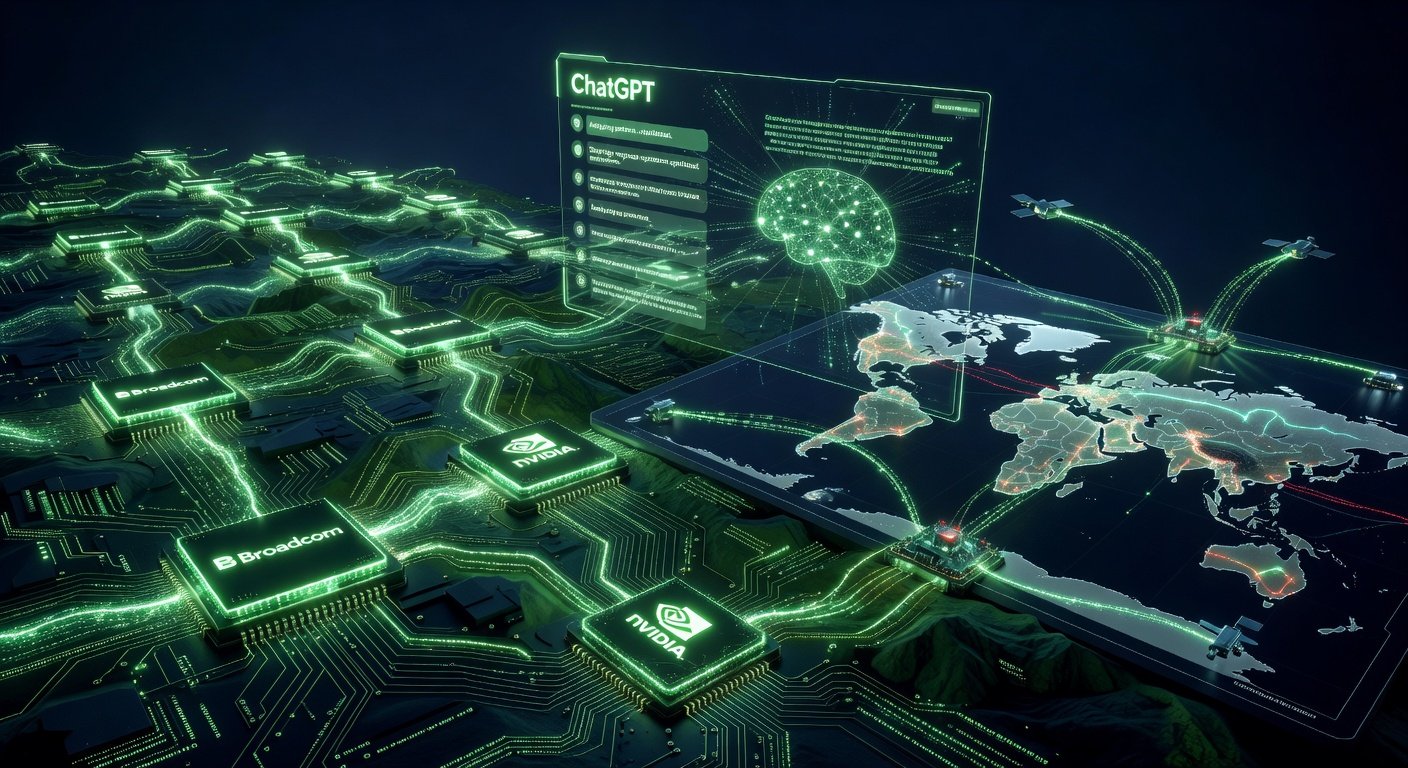
The AI industry rarely sleeps — but this week, it hit the accelerator. From a seismic shift in the AI chip race to a stealthy ChatGPT upgrade and the explosive debate over AI on the battlefield, March 2026 is shaping up to be one of the most consequential months in artificial intelligence history. Buckle up.
Broadcom Takes Aim at Nvidia’s AI Chip Crown
For years, Nvidia has been the undisputed king of AI hardware. But Broadcom is making its boldest move yet to challenge that throne. The company announced a staggering $73 billion AI chip backlog and projected that its AI chip sales will surpass $100 billion by 2027 — more than double its current AI revenue of $8.2 billion.
This isn’t just a financial milestone. It signals a fundamental restructuring of the AI semiconductor market. Broadcom’s strategy centers on custom AI accelerators (XPUs) built for hyperscalers like Google and Meta, offering an alternative to Nvidia’s general-purpose GPUs. As AI infrastructure spending accelerates globally, enterprises and cloud giants are actively diversifying their chip suppliers to reduce dependency and cost.
- $73B AI backlog confirms massive enterprise demand
- Custom XPU chips target Google, Meta, and other hyperscalers
- Broadcom’s market cap has surged over 40% in the past 12 months
The implications for the AI chip competition are profound: investors, developers, and enterprises should watch this space closely as pricing power and supply chains shift.
OpenAI Quietly Drops GPT-5.3 Instant — And It’s a Big Deal
On March 4, 2026, OpenAI released GPT-5.3 Instant, a targeted upgrade to ChatGPT that focuses on what users have been demanding for months: better conversational flow, sharper relevance, smarter web search integration, and — perhaps most notably — fewer defensive refusals.
That last point matters more than it sounds. One of the most persistent criticisms of large language models has been their tendency to over-refuse legitimate queries, frustrating users and limiting practical utility. GPT-5.3 Instant appears designed to recalibrate that balance, delivering more direct, actionable responses without sacrificing safety guardrails entirely.
Simultaneously, Google researchers unveiled Bayesian teaching, a groundbreaking training methodology that enables LLMs to update probabilities dynamically as new evidence is introduced. In multi-round reasoning tasks where standard models plateau, Bayesian-trained models achieved approximately 80% accuracy — a leap that could redefine how AI handles complex, evolving conversations and real-world problem-solving.
Military AI: The Geopolitical Flashpoint Nobody Can Ignore
Perhaps the most consequential — and controversial — development this week involves AI on the battlefield. Anthropic has restarted Pentagon talks regarding military AI applications, following reports that Claude AI, combined with Palantir’s defense tools, was used in operational planning connected to US strikes on Iran.
The fallout was immediate. China issued formal warnings about the weaponization of AI, framing the development as a dangerous escalation in global security dynamics. The episode raises urgent questions that the tech industry can no longer sidestep:
- Where are the ethical boundaries for AI in lethal decision-making?
- How do AI companies balance defense contracts with their stated safety missions?
- What international frameworks — if any — can govern military AI applications?
Anthropic’s re-engagement with the Pentagon suggests that, despite public commitments to responsible AI, the commercial and strategic pull of defense contracts is powerful. This tension between AI ethics and national security will define policy debates for years to come.
What This All Means for the Future of AI
Zoom out, and a clear picture emerges: AI is no longer a technology of the future — it is the infrastructure of the present, and the stakes have never been higher. The AI chip market is diversifying, making the ecosystem more competitive and resilient. Language models are becoming smarter and more useful with each iteration. And AI’s role in geopolitics is accelerating faster than regulation can follow.
For businesses, the message is clear: AI adoption is no longer optional. The companies investing in AI infrastructure, talent, and strategy today will define their industries tomorrow. For policymakers, the military AI debate demands urgent, coordinated international dialogue before the technology outpaces governance entirely.
The bottom line: Whether you’re a developer, investor, business leader, or concerned citizen, the AI developments of March 2026 demand your attention. The race is on — and the finish line keeps moving.