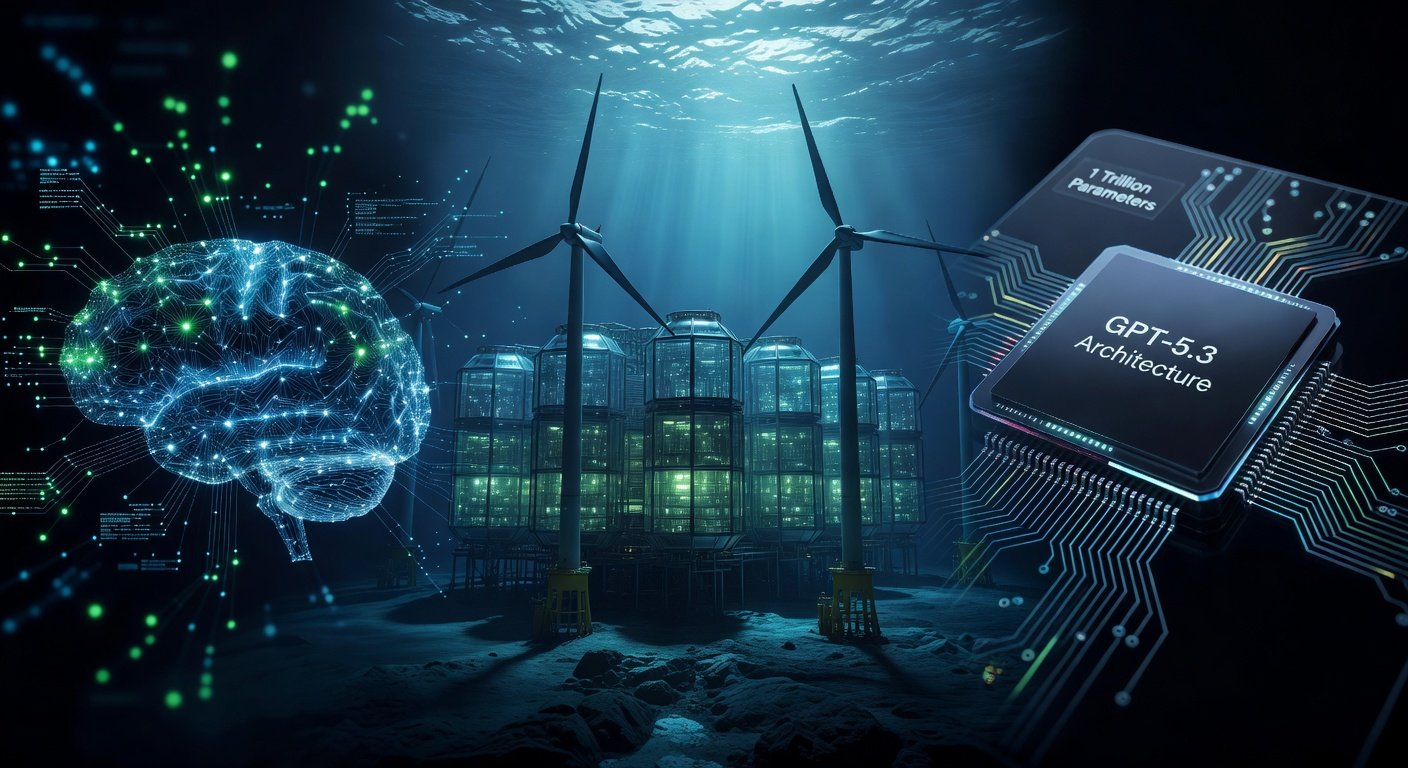
The artificial intelligence industry rarely slows down, but every so often a cluster of announcements arrives that fundamentally shifts the trajectory of the entire sector. This week is one of those moments. From OpenAI’s surprisingly compact yet powerful GPT-5.3 ‘Garlic’ model to DeepSeek’s jaw-dropping trillion-parameter architecture and the emergence of wind-powered underwater data centers, 2025 is already proving to be a landmark year for AI innovation.
OpenAI’s GPT-5.3 ‘Garlic’: Smarter, Leaner, and More Honest
OpenAI has officially unveiled GPT-5.3, codenamed ‘Garlic’, a model that punches well above its weight class. Rather than simply scaling up parameters, OpenAI engineered a smaller, faster architecture capable of delivering GPT-6 level reasoning at a fraction of the computational cost. The model entered preview access for select partners in January, with a full API rollout scheduled for mid-March and free-tier integration to follow shortly after.
What makes GPT-5.3 particularly noteworthy is its focus on conversational naturalness and reduced deceptive behavior. According to OpenAI’s internal benchmarks, the model reduces deceptive or misleading outputs to just 2.1%, a significant step forward in AI alignment and trustworthiness. For enterprise developers and everyday users alike, this means more reliable, context-aware interactions that feel genuinely human.
- Architecture: Compact design achieving GPT-6 class reasoning
- Rollout: Partner preview (January) → Full API (mid-March) → Free tier (TBD)
- Safety metric: Deceptive behavior reduced to 2.1%
DeepSeek V4: One Trillion Parameters and a Memory Revolution
Not to be overshadowed, Chinese AI powerhouse DeepSeek has launched DeepSeek V4, a colossal model boasting 1 trillion parameters and a suite of architectural innovations that address some of the most persistent bottlenecks in large-scale AI deployment.
At the heart of DeepSeek V4 is the new MODEL1 architecture, which delivers a remarkable 40% reduction in memory consumption compared to previous generations. Paired with sparse FP8 decoding, the model achieves a 1.8x inference speedup, making real-time applications significantly more feasible at scale. Perhaps most impressively, DeepSeek V4 supports efficient context windows exceeding 1 million tokens, opening the door to unprecedented document analysis, legal review, and long-form reasoning tasks.
These advancements signal a broader industry shift: raw parameter counts matter less than architectural elegance and operational efficiency. DeepSeek V4 is a direct challenge to Western AI dominance and proof that the global AI race is more competitive than ever.
Sustainable AI: Offshore Wind-Powered Underwater Data Centers
As AI models grow in complexity, their energy footprint has become a pressing concern for regulators, investors, and the public. A groundbreaking solution is now emerging: offshore wind-powered underwater data centers. These facilities, positioned beneath the ocean surface near wind energy installations, leverage the natural cooling properties of seawater while drawing power directly from renewable offshore turbines.
This infrastructure model represents a potential paradigm shift for the industry. By co-locating compute power with clean energy generation, companies can dramatically reduce both carbon emissions and cooling costs, two of the largest operational expenses in modern AI infrastructure. Analysts are already calling this one of the most promising sustainable AI breakthroughs of the decade.
Hardware Boom: Broadcom Eyes $100 Billion in AI Chip Sales
Underpinning all of these software and infrastructure advances is a surging demand for specialized AI hardware. Broadcom has projected a staggering $100 billion in AI chip sales by next year, reflecting massive anticipated deliveries to hyperscalers and cloud providers. This forecast reinforces the hardware sector’s central role in the AI economy and signals continued investment in custom silicon, accelerators, and next-generation networking chips.
What This Means for the Future of AI
The convergence of efficient reasoning models, trillion-parameter architectures, green infrastructure, and booming hardware demand paints a clear picture: AI in 2025 is defined by doing more with less. Efficiency, sustainability, and trustworthiness are no longer optional — they are competitive advantages. Businesses that align their AI strategies with these principles will be best positioned to thrive in the next wave of digital transformation.
Key takeaway: Whether you are a developer evaluating GPT-5.3’s API, an enterprise architect exploring DeepSeek V4’s long-context capabilities, or an investor tracking Broadcom’s hardware trajectory, the message is the same — the AI landscape is evolving faster than ever, and staying informed is your most valuable edge.