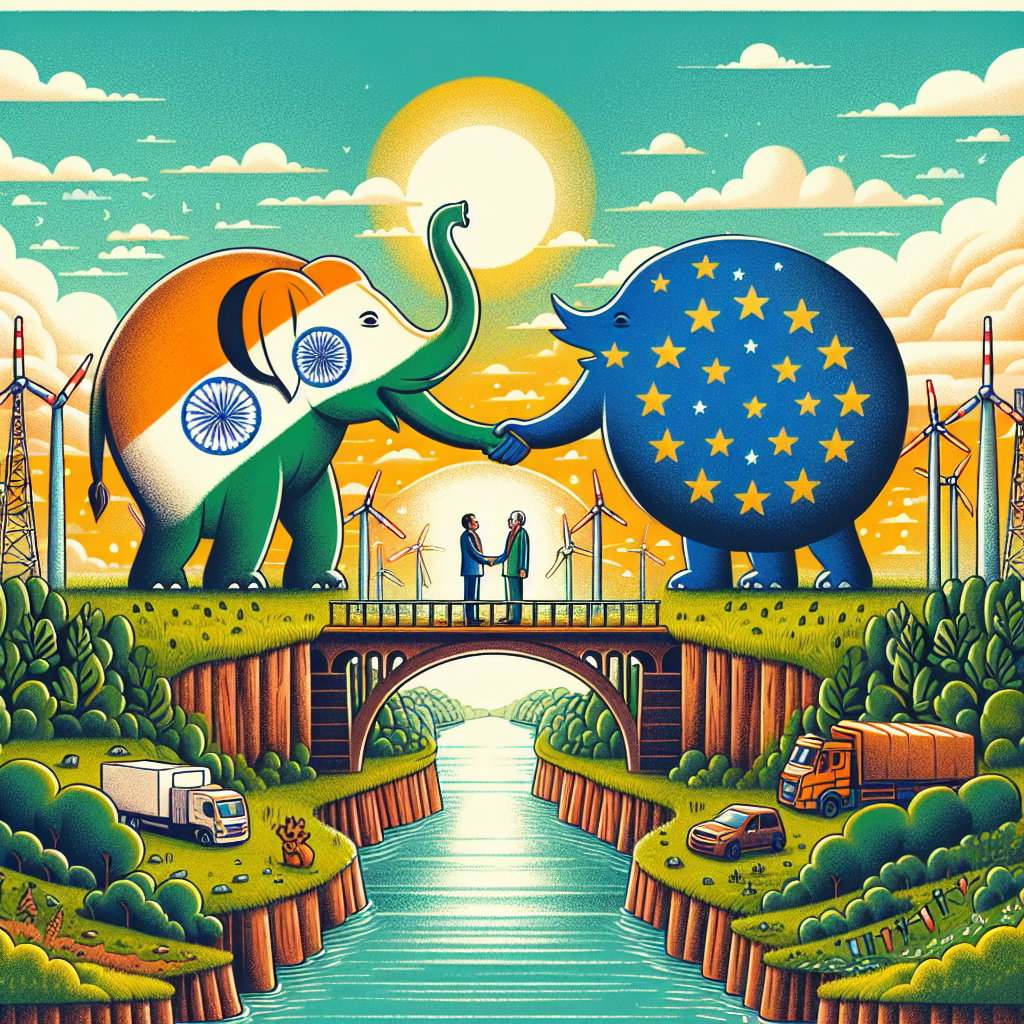
# India and European Union Close ‘Landmark’ Free Trade Deal, Prime Minister Modi Says
In a historic development, India and the European Union have successfully concluded negotiations for a **Free Trade Agreement (FTA)**, hailed as a “landmark” deal by Prime Minister Narendra Modi. This agreement promises to reshape bilateral trade dynamics, boosting exports and integrating two of the world’s largest economies.[1][2]
The announcement came shortly after EU leaders participated in India’s Republic Day celebrations for the first time, marking a pivotal moment in relations between these democratic powers. PM Modi described it as “another such moment, when two major democratic powers are adding a decisive chapter in their relationship.”[1] The EU, ranking among India’s top trading partners, saw merchandise trade reach Rs 11.5 lakh crore ($136.54 billion) in 2024–25, with Indian exports at Rs 6.4 lakh crore ($75.85 billion) and imports at Rs 5.1 lakh crore ($60.68 billion). Services trade added Rs 7.2 lakh crore ($83.10 billion) during the same period.[1]
Together, India (the fourth-largest economy) and the EU (second-largest) account for about **25% of global GDP** and nearly one-third of world trade. This complementary economic partnership positions the FTA as a platform for unlocking vast opportunities in trade and investment.[1][2]
## Key Benefits for India: Tariff Cuts and Market Access
The deal delivers **extensive market access** for Indian exports, with over **99% of exports by trade value** gaining entry into the EU market.[1] It features deep tariff liberalisation: the EU will open **96.8% of its tariff lines**, while India opens **92.1%**.[1]
Labour-intensive sectors stand to gain the most. Tariffs of up to 10% will be eliminated on nearly **$33 billion** of Indian exports in textiles, apparel, leather, footwear, marine products, gems and jewellery, handicrafts, engineering goods, and automobiles—right upon entry into force.[1] Zero tariffs will apply to gems, jewellery, and plastics, enhancing competitiveness for these industries.[1]
For India, tariffs on EU goods will reduce to zero for **93% of bilateral trade value** over 10 years. The EU will phase out tariffs on Indian goods over seven years, excluding sensitive sectors like automobiles, steel, and agriculture.[1] This phased approach balances immediate gains with protections for domestic industries.
The agreement also addresses strategic concerns. India secures flexibility on the EU’s carbon tax regime, contingent on similar treatment for other nations. The EU commits to **uncapped mobility for Indian students**, fostering talent exchange. India is pushing for a higher steel export quota as an FTA partner.[1]
## Advantages for the European Union and Mutual Gains
The FTA grants EU companies **privileged access** to India’s services market, particularly in financial services and other key sectors.[3] This opens doors for European firms in a fast-growing economy, enhancing bilateral investment ties.[2]
Overall, the deal strengthens the India-EU Strategic Partnership, described as a “milestone” by the European Commission. It will significantly boost trade volumes, embed Indian firms in global value chains, and reinforce India’s role as a reliable supplier.[1][2]
## Broader Economic Impact
This FTA arrives at a critical juncture. India seeks to diversify exports amid US tariffs under President Donald Trump, which reached 50% on certain goods.[1] By aligning with the EU, India mitigates risks and taps into a massive market.
Winners extend beyond large exporters. The gains will support **workers, artisans, women, youth, and MSMEs** (micro, small, and medium enterprises), creating jobs and empowering local economies.[1] Enhanced global value chain integration could spur innovation and manufacturing upgrades.
Challenges remain, however. Sensitive sectors like agriculture and steel are shielded, but negotiations ensured balanced concessions. Ratification and implementation will require parliamentary approvals on both sides, with tariffs phasing in over 7-10 years.[1]
## A New Chapter in Global Trade
PM Modi’s endorsement underscores the deal’s transformative potential: the “mother of all trade deals” for India.[1] As negotiations conclude, both sides exchange political declarations, signaling swift progress toward signing.[1]
This landmark FTA not only elevates India-EU ties but also sets a precedent for plurilateral trade in a fragmented world. Expect surges in bilateral trade, investment flows, and people-to-people connections, propelling shared prosperity.
(Word count: 812)
Original source: CNBC Business – India and European Union have closed a ‘landmark’ free trade deal, Prime Minister Modi says
Leave a Reply