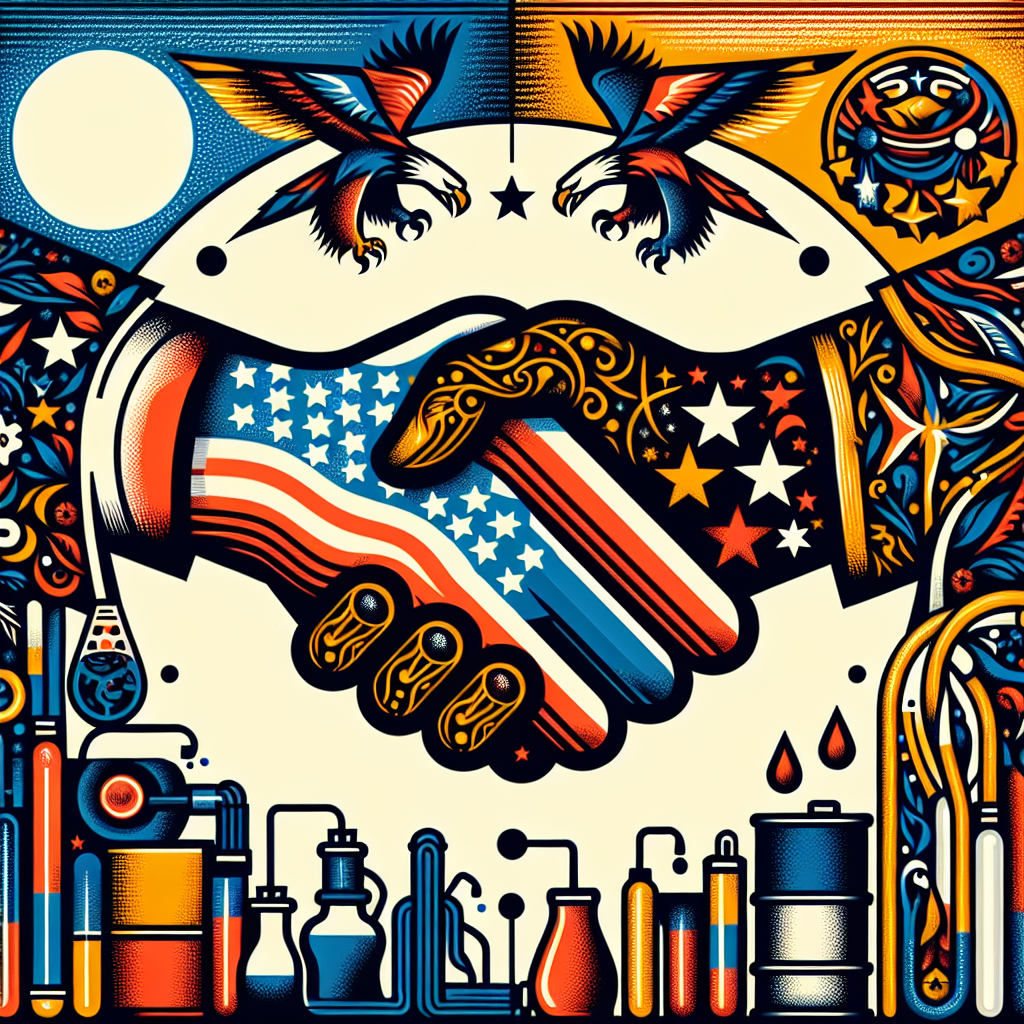
Donald Trump has announced that **Venezuela will purchase American products using revenue from a new U.S.–Venezuela oil deal**, positioning the agreement as both an energy strategy and a diplomatic breakthrough in the Western Hemisphere.[1] According to a fact sheet from the U.S. Department of Energy, the arrangement is framed as a way to “restore prosperity, safety, and security to the United States and Venezuela” while channeling Venezuela’s oil income back into the U.S. economy through targeted purchases of American goods.[1]
For observers of U.S. energy policy and hemispheric relations, this marks a notable shift. For years, Washington’s relationship with Caracas was defined by sanctions, mutual accusations, and collapsing trade. By contrast, this new deal suggests a transactional reset: the U.S. opens the door to Venezuelan oil, and in return, Venezuela commits to spending a portion of its oil-derived revenue on products made in America.[1]
From a U.S. perspective, the agreement serves several political and economic objectives. First, it aligns with Trump’s long-standing emphasis on **energy dominance** and on leveraging American energy policy to shape geopolitical realities. The administration is presenting the deal as a way to stabilize regional energy flows, reduce the influence of rival powers in Venezuela’s oil sector, and create a controlled channel for Venezuelan crude that benefits U.S. interests.[1] Instead of merely allowing Venezuelan oil back onto global markets, the deal attempts to capture part of the value chain: if Caracas must buy American, then U.S. firms in manufacturing, agriculture, technology, and energy services could see new export opportunities.
Second, tying oil revenue to American purchases fits squarely with Trump’s “America First” economic messaging. Rather than purely humanitarian or diplomatic concessions, the agreement is being marketed as a **jobs and exports** package for U.S. workers and companies.[1] Oil income that might otherwise flow to suppliers in Europe or Asia could be redirected to American producers of machinery, industrial equipment, food products, consumer goods, and possibly oilfield services. In effect, Venezuela becomes both a supplier of crude and a captive customer for U.S. industry.
For Venezuela, the deal represents a potential lifeline out of prolonged economic crisis. Years of sanctions, mismanagement, and underinvestment left the country’s oil industry degraded and its access to international finance severely constrained. By striking an arrangement with Washington, Caracas may regain crucial access to global markets and hard currency, albeit under conditions that limit its freedom to choose how and where it spends that income. The promise of using oil revenue to purchase American products could be pitched domestically as a pragmatic step toward recovery: if imports of U.S. food, medicine, industrial parts, and infrastructure inputs increase, Venezuelan citizens could see tangible if uneven improvements in daily life.
However, the structure of this deal raises important questions. One is the **degree of conditionality**: how much of Venezuela’s oil revenue must be spent on American products, over what timeframe, and in which sectors? The more rigid the conditions, the more the agreement resembles a managed trade framework rather than a purely market-based opening. That kind of design could generate friction within Venezuela, where critics may argue that the country is trading one form of dependency for another, swapping isolation for a tightly circumscribed economic relationship with the United States.
Another key issue is governance and enforcement. Trump’s announcement emphasizes restoring “safety and security,” language that suggests the deal is also being tied to expectations about regional stability, migration, and possibly internal reforms in Venezuela.[1] If future disbursements or trade flows are linked to benchmarks—such as steps on democratic processes, anti-corruption measures, or cooperation on transnational crime—that conditionality will become a central point of contention. Investors, humanitarian advocates, and political opposition groups will all be watching how Washington uses this new leverage.
From the standpoint of global energy markets, the U.S.–Venezuela arrangement could modestly affect crude supply and price dynamics. Reintegrating Venezuelan barrels, even partially, can contribute to supply diversity, especially for refiners configured for heavier crude. At the same time, by routing benefits through American exports, the U.S. administration can claim that it has not simply “bailed out” the Venezuelan government but has structured the deal to serve domestic economic goals. The fact sheet from the Department of Energy highlights that the broader initiative is about “restoring prosperity” not just in Venezuela but in the United States itself, underscoring the political narrative that this is as much an American jobs program as a foreign policy move.[1]
There is also a strategic communications dimension. By publicly stating that Venezuela will buy American products with its oil revenue, Trump is sending a signal to both domestic and international audiences: U.S. engagement comes with explicit economic expectations. For allies and rivals alike, the message is that access to U.S. markets and regulatory relief will be tied to clear, transactional commitments that can be easily explained to American voters.
Critics will likely raise concerns on several fronts. Human rights groups and parts of the Venezuelan diaspora may worry that re-legitimizing and financially empowering the current leadership in Caracas could entrench authoritarian practices if not coupled with firm political conditions. Trade analysts may question whether such explicitly tied arrangements distort markets or invite retaliation and copycat deals elsewhere. Environmental advocates will argue that doubling down on oil trade, rather than accelerating a transition to low-carbon energy, runs counter to long-term climate objectives.
Supporters, on the other hand, will emphasize potential **mutual benefits**: an economically stabilized Venezuela could see reduced outward migration and social unrest, while U.S. companies secure new export markets and American refineries access a predictable stream of crude. The administration is likely to portray any uptick in U.S. manufacturing orders, port activity, or agricultural exports linked to this deal as proof of concept that hard-nosed bargaining can turn foreign policy into tangible domestic gains.
As with any complex energy and trade arrangement, the ultimate impact will depend on implementation. The headline pledge—that Venezuela will purchase American products with revenue from its oil—offers a clear, easily communicated metric that both governments will be judged against. Whether this promise translates into durable economic recovery for Venezuela and lasting prosperity and security gains for the United States will hinge on the details that extend beyond the announcement itself, and on how those details adapt to shifting political and market realities.[1]
Original source: CNBC Business – Trump says Venezuela will purchase American products with revenue from oil deal