Full HTML article body
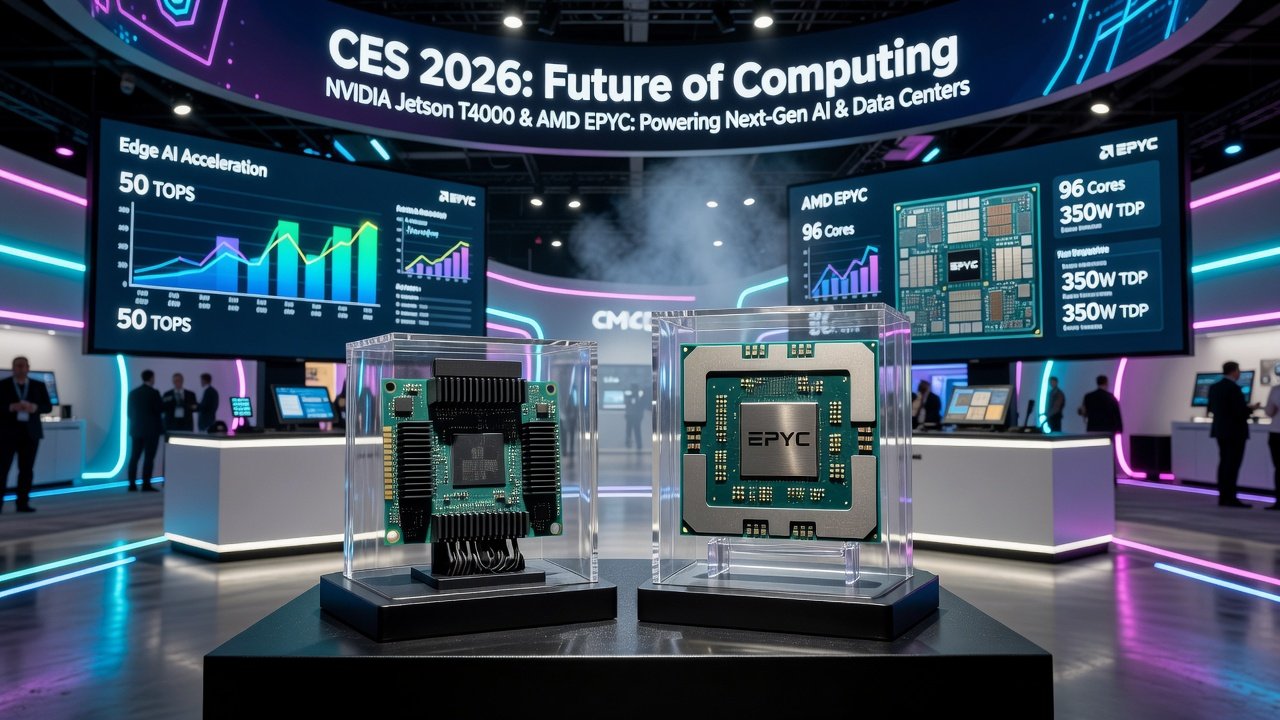
The edge AI race has a new benchmark. At CES 2026, NVIDIA’s 1200 TFLOPS Jetson T4000 and AMD’s 2nm EPYC Venice headline a wave of AI and robotics hardware breakthroughs shaping edge computing in 2026. The Jetson T4000 is built on NVIDIA’s latest architecture, providing unprecedented performance for AI workloads. Meanwhile, AMD’s EPYC processors are pushing the boundaries of efficiency and power, making them ideal for data centers and edge applications alike.
As the demand for AI capabilities grows, companies are racing to develop hardware that can keep up. The Jetson T4000 is designed for high-performance computing, enabling developers to create advanced AI applications that can operate in real-time. With its ability to process vast amounts of data quickly, it is set to revolutionize industries such as robotics, autonomous vehicles, and smart cities.
On the other hand, AMD’s EPYC processors are making waves in the server market. With their 2nm process technology, they offer improved performance per watt, allowing data centers to run more efficiently. This is crucial as companies look to reduce their carbon footprint while still meeting the demands of modern computing.
The competition between NVIDIA and AMD is heating up, with both companies vying for dominance in the AI hardware space. As we move further into 2026, it will be interesting to see how these advancements shape the future of technology and the role of AI in our daily lives.