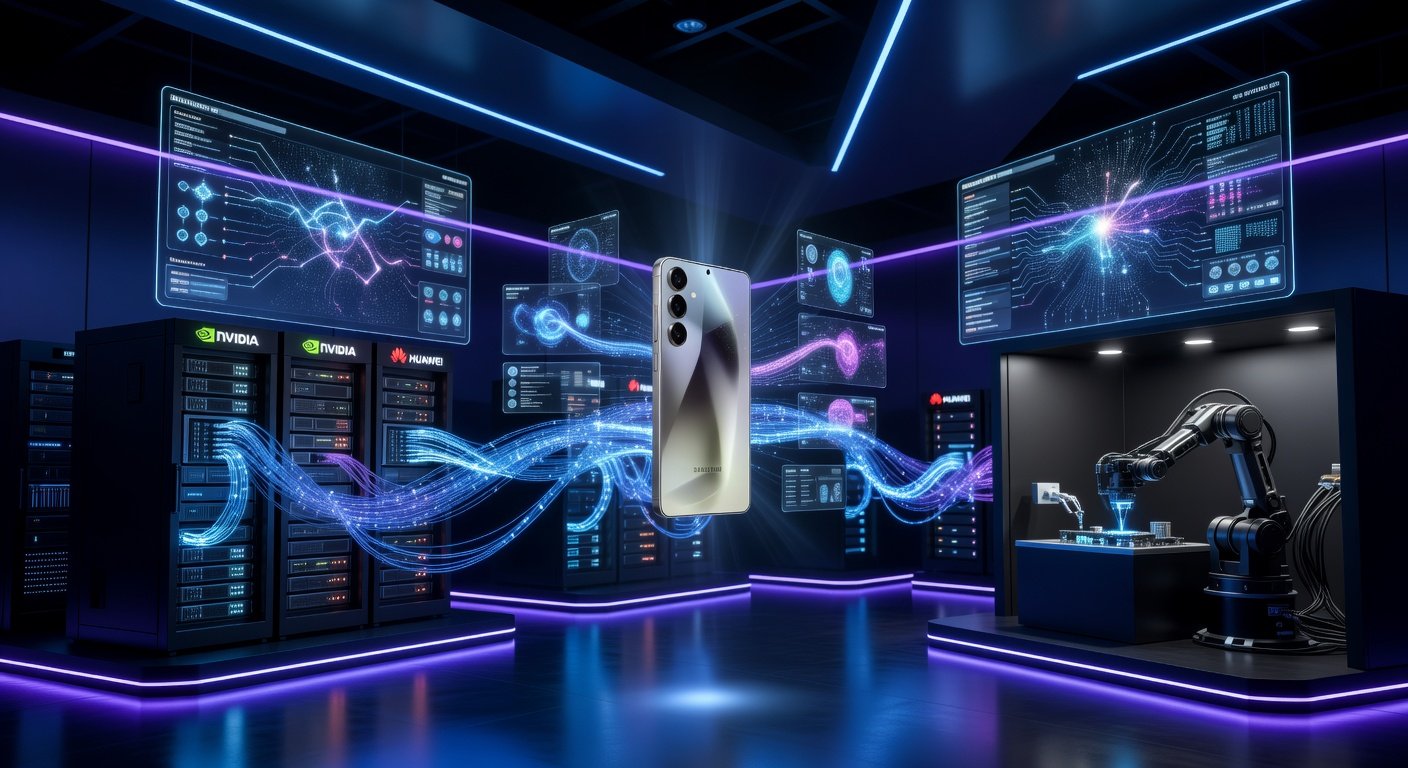
Imagine your phone anticipating your needs before you voice them, your factory running itself, and your entire telecom network managed by autonomous AI agents. That future arrived this week at MWC 2026 — and the announcements from Samsung, Huawei, and NVIDIA suggest we are no longer talking about incremental upgrades. We are talking about a fundamental rewiring of how technology works.
Samsung’s Galaxy S26: Agentic AI Moves From Buzzword to Reality
Samsung took the spotlight at MWC 2026 with the unveiling of the Galaxy S26 series, its third-generation AI-powered smartphone. But this is not simply a hardware refresh. The Galaxy S26 introduces Agentic AI — a paradigm shift where your device does not just respond to commands, it proactively acts on your behalf.
Key features include:
- Now Brief: A contextual AI layer that surfaces relevant information, reminders, and suggestions based on your habits and schedule — without you asking.
- Enhanced Circle to Search: Samsung’s popular visual search tool now integrates deeper AI reasoning, enabling more nuanced, multi-step queries directly from your camera.
- Cross-ecosystem AI: Galaxy AI extends seamlessly across Samsung wearables, smart home devices, and even industrial platforms.
Perhaps most ambitiously, Samsung announced AI-Driven Factories targeting fully autonomous manufacturing operations by 2030, alongside a Network in a Server solution designed to bring edge AI capabilities directly into telecom infrastructure. Samsung is not just building a smarter phone — it is building a smarter world around it.
Huawei and NVIDIA: The Race to Build AI-Native Networks
On the network side, two giants made moves that will shape the backbone of tomorrow’s connectivity. Huawei unveiled its Next-Gen AI-Native Intelligent Operations Solution, a bold step toward fully autonomous network management. Built on a three-layer framework — Platform, Agent, and Service — Huawei’s architecture deploys proactive AI Agents that monitor, diagnose, and optimize telecom networks in real time, targeting Autonomous Networks Level 4, where human intervention becomes the exception rather than the rule.
Meanwhile, NVIDIA announced strategic partnerships with global telecom leaders to co-develop 6G infrastructure on open, secure, AI-native platforms. Announced on March 1, 2026, the initiative positions NVIDIA’s AI computing stack as the engine powering next-generation wireless networks — bringing GPU-accelerated intelligence directly into the telecom core.
Together, these announcements confirm a clear industry consensus: the future of connectivity is not just faster, it is fundamentally intelligent.
The Human Cost: Block’s 40% Layoffs Sound a Warning Bell
Not all the week’s headlines were celebratory. Block announced a 40% workforce reduction, explicitly citing AI-driven efficiency gains as the primary driver. The company’s stock surged 14% in response — a stark illustration of the uncomfortable math now confronting white-collar industries worldwide.
The announcement echoed a wave of viral essays warning of accelerating AI-driven job displacement among knowledge workers. As agentic AI systems take on tasks once reserved for human analysts, project managers, and operations staff, the productivity gains for companies are real — and so are the consequences for employees.
This is the dual reality of the AI moment: extraordinary capability growth paired with genuine disruption to livelihoods. The conversation can no longer be deferred.
Industry Implications and What Comes Next
The themes emerging from MWC 2026 point toward several critical shifts across industries:
- Telecom operators must accelerate investment in AI-native infrastructure or risk obsolescence as Huawei and NVIDIA redefine network standards.
- Consumer device makers face pressure to match Samsung’s agentic capabilities, raising the bar for what a smartphone is expected to do.
- Enterprise leaders must balance AI efficiency gains with thoughtful workforce transition strategies — or face reputational and regulatory backlash.
- Regulators and policymakers are on notice: autonomous networks, agentic devices, and mass layoffs demand updated frameworks for accountability and worker protection.
The convergence of 6G, edge AI, and agentic systems is not a 2030 story. The infrastructure decisions being made right now — at MWC 2026, in boardrooms, and in government offices — will determine who leads and who lags in the AI-native era.
The takeaway is clear: MWC 2026 was not a trade show. It was a preview of a world where AI is not a feature — it is the foundation. Whether you are a consumer, a business leader, or a policymaker, the time to engage with that reality is now.