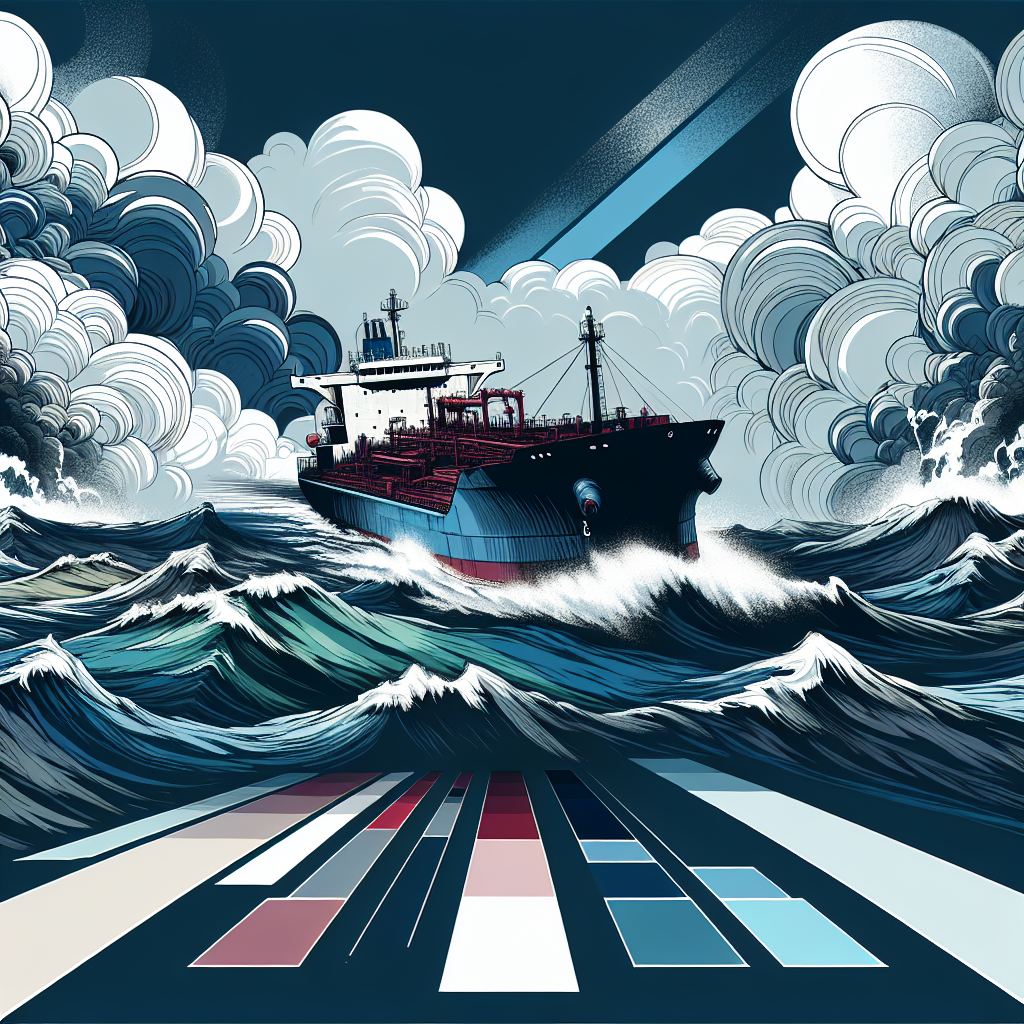
The United States has seized a **fifth oil tanker linked to Venezuela**, a vessel named **Olina**, in the Caribbean, escalating Washington’s maritime crackdown on sanctioned Venezuelan oil exports.[2][3]
U.S. Southern Command confirmed that U.S. forces boarded and detained the Olina in a **pre-dawn operation** in the Caribbean Sea, describing the action as part of an ongoing campaign against **sanctions evasion and illicit oil trafficking**.[1][2][4] Officials said the seizure occurred *without incident*, with U.S. Marines and Navy personnel taking control of the ship in coordinated fashion.[3][4]
According to U.S. officials and shipping data cited in media reports, the Olina had **recently departed Venezuela** and was suspected of transporting **embargoed Venezuelan crude** in violation of U.S. sanctions.[2][3] Homeland Security Secretary **Kristi Noem** wrote on social media that the tanker had left Venezuela “attempting to evade U.S. forces,” underscoring the administration’s portrayal of the ship as part of a broader “shadow fleet” built to bypass sanctions and obscure the origin of cargoes.[2][3]
Reports indicate that the Olina had previously operated under a different name, **Minerva M**, and had already been **sanctioned by the United States** for participation in opaque shipping networks moving restricted oil.[1][2] Such ships are often characterized by **frequent name changes**, complex or hidden ownership structures, and **flag-hopping**—in this case, the vessel was reportedly **flying the flag of Timor Leste** despite questions about the legitimacy of that registration.[1][2] These tactics are common in sanction-evasion schemes involving Iran, Russia, and Venezuela, and have been closely tracked by U.S. authorities and maritime insurers.[1]
The seizure of the Olina is the **fifth such action since early December**, part of what President Donald Trump and senior officials have described as a **global maritime blockade** of sanctioned Venezuelan oil.[2][3] Earlier in the campaign, U.S. forces intercepted and seized at least **four other tankers**:
– The **Bella 1**, which had reportedly been renamed **Marinera** and sailed under a **Russian flag**, was taken in the North Atlantic after what officials described as a weekslong pursuit.[2]
– The **Sophia**, another sanctioned tanker, was intercepted in the Caribbean and accused of “illicit activities” related to embargoed oil.[2]
– Two additional tankers were previously seized off **Venezuela’s coast** as the crackdown began, reinforcing the message that U.S. enforcement would not be limited to U.S. territorial waters.[2]
U.S. defense officials, including the commander of the task force responsible for the operation—**Joint Task Force Southern Spear**—have framed the campaign as “unwavering” and focused on **“ending illicit activity and restoring security in the Western Hemisphere.”**[2][4] By targeting vessels on the high seas and in international shipping lanes, the administration is signaling its willingness to enforce sanctions **“anywhere in the world,”** a phrase attributed to Defense Secretary Pete Hegseth, which has rattled global shipping firms and some foreign governments.[2]
The tanker seizures are unfolding against a dramatic political backdrop. Just days earlier, U.S. forces captured **Venezuelan President Nicolás Maduro** in a special operation, leaving the country’s already fragile oil sector in deeper turmoil and elevating interim authorities backed by Washington.[2][4] The Trump administration argues that tightening control over Venezuela’s oil exports is crucial to **cutting off revenue streams** linked to corruption and authoritarian governance, and to strengthening the interim government’s leverage.[2][3]
In public remarks, President Trump has tied the maritime campaign directly to a broader strategy of **rebuilding Venezuela’s oil industry under new management**.[2][4] He has scheduled meetings with executives from major oil and gas companies to discuss **reinvesting in and modernizing Venezuela’s energy infrastructure**, positioning U.S. involvement as central to any future recovery.[4] Trump has also boasted that the United States will assume control over large volumes of seized oil, suggesting that **Washington—not Caracas—will manage the proceeds** as long as the current sanctions and intervention framework remains in place.[2]
Yet the expanding pattern of tanker seizures raises **legal and geopolitical questions**. International maritime lawyers and foreign officials have begun debating how far a single country can go in asserting **jurisdiction on the high seas** under the banner of sanctions enforcement.[2] Venezuelan authorities and allies such as Russia have condemned the actions as a violation of sovereignty and freedom of navigation, warning of the risk of escalation.[2] In the case of the Bella 1/Marinera, Trump claimed that **Russia had initially dispatched a submarine and a destroyer** to accompany the tanker but withdrew when confronted by U.S. forces—an episode that underscores the potential for great-power friction around energy flows and sanctions.[2]
For Venezuela, the stakes are existential. The country **depends heavily on oil exports** for government revenue and foreign currency, and years of mismanagement, prior sanctions, and infrastructure decay have already crippled production.[2] Each seized tanker not only removes a cargo from the market but also **deters shipowners, insurers, and traders** from touching Venezuelan barrels, effectively amplifying the impact of formal sanctions through market fear.[1][2] With Maduro detained, interim authorities are cooperating with Washington, but key members of the old regime remain in the country, and the oil sector’s future is deeply uncertain.[4]
Meanwhile, shipowners and charterers operating in or near the Caribbean now face a far more **risk-laden environment**. U.S. officials have made clear that vessels suspected of carrying embargoed Venezuelan oil—especially those engaging in deceptive practices like **AIS (transponder) dark periods**, suspicious ship-to-ship transfers, or irregular flagging—could be subject to **boarding, seizure, and forfeiture**.[1][2] For the global shipping industry, the Olina’s capture is both a warning and a precedent: a demonstration that the United States is prepared to project power at sea to enforce its sanctions regime on Venezuela, and that the era of relatively low-risk sanctions evasion for Caracas-linked oil may be coming to an end.[1][2][3]
Original source: BBC News – US seizes fifth oil tanker linked to Venezuela, officials say