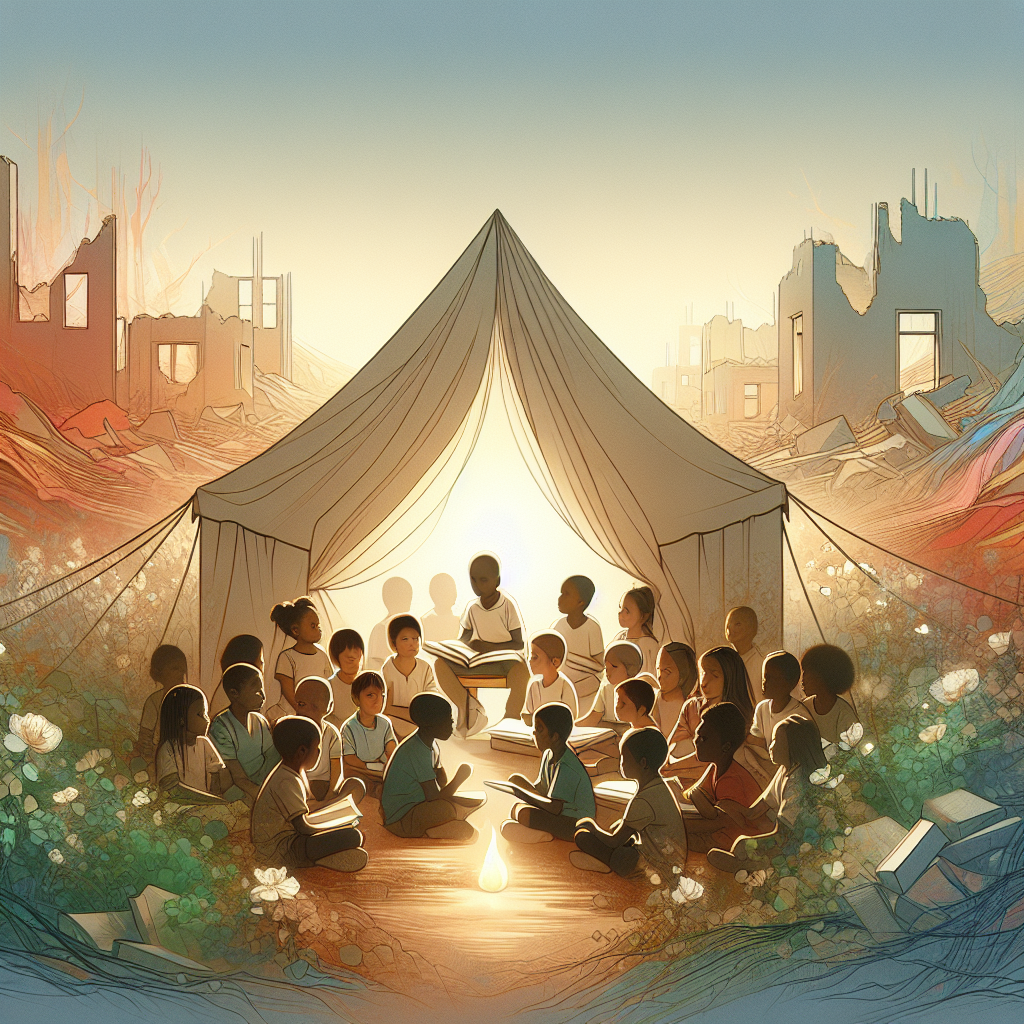
Children in Gaza are returning to school in **tents and shattered buildings**, trying to rebuild their futures after nearly two years without formal education.[1][2] Their return is fragile, incomplete, and taking place amid deep trauma and widespread destruction, but it represents a powerful act of hope.
For almost five years, Gaza’s children have endured rolling school closures: first because of Covid-19, then because of repeated wars that damaged or destroyed nearly every school building in the territory.[2][3] According to UNICEF and independent researchers, more than **97% of schools in Gaza have been damaged or destroyed**, and children have effectively lost the equivalent of **five full years of schooling** since 2020.[1][2][3][5] Many of the surviving school buildings became shelters for displaced families, turning classrooms into crowded dormitories instead of places of learning.[2]
The recent ceasefire has allowed a **limited, improvised reopening** of education. In Gaza City, lessons have resumed not in proper classrooms, but in **tents erected amid the ruins** of schools hit by airstrikes.[1][7] At the former Lulwa Abdel Wahab al-Qatami School, now a temporary learning centre, teachers write English letters and basic Arabic on makeshift boards while children pack into canvas shelters pitched over rubble.[1] The atmosphere is described as “lively and a little chaotic,” but the sound of children reciting lessons is back for the first time in nearly two years.[1][7]
These tent schools are run mainly by **UNICEF, UNRWA and the Gaza education authorities**, trying to offer at least a core curriculum despite minimal resources.[1][2] Most classes are limited to **Arabic, English, mathematics and science**, far short of the full Palestinian syllabus.[1] One UNICEF-supported school in Gaza City hosts about **1,100 pupils in three daily shifts**, with boys and girls attending on alternating days because there is so little space.[1] Only **24 teachers** handle this enormous load, and they do so without electricity, internet, or basic teaching materials.[1]
Behind the numbers are children who have experienced what no child should. Many have spent months displaced, hungry, and grieving; more than 100 pupils at just one temporary school have lost one or both parents or seen their homes destroyed.[1] Teachers report that students struggle with concentration, nightmares and anxiety, making learning far harder than simply “catching up” on missed content.[1][2][3][5] One major study warns that the war’s combined effects of **trauma, malnutrition and destruction of schools** could create a “lost generation” of Gazan children who may never fully regain their educational footing.[2][3][5][6]
Still, for many pupils, returning to class—however imperfect—brings a measure of **normalcy and dignity**. Fourteen-year-old Naeem, who lost his mother in an airstrike, describes coming back to school as a way to reclaim part of his old life.[1] He notes that education now happens in tents, with fewer subjects and overcrowded spaces, but insists that “being here matters.”[1] Another student, Rital, a ninth-grader who dreams of becoming a dentist, speaks of the pain of years without school and the joy of seeing classmates again, even in such harsh conditions.[1]
Parents often feel both relief and fear. One mother of five, displaced from Gaza City’s Rimal neighbourhood, says her children are several years behind and that basic supplies are now **prohibitively expensive**: a notebook that once cost one shekel now costs five.[1][2] Research backs up these testimonies: with Israel blocking many educational and recreational materials on the grounds that they are not “humanitarian goods,” a single sheet of paper can cost several dollars, and printing home-learning materials can be ten times more expensive than before.[2] UNICEF and other agencies say restrictions on aid have sharply limited the flow of notebooks, pens and psychosocial support kits into Gaza.[1][2]
Teachers and school leaders are carrying a burden that is both educational and deeply emotional. Principals speak of starting again “with determination to compensate students for what they lost,” even as they confront the reality that **thousands of new teachers and counsellors** will eventually be needed to rebuild the system.[1][2] A small number of counsellors now offer psychological support inside tent schools, but demand far exceeds capacity.[1][2] Researchers emphasize that any serious recovery plan must invest in teachers as the backbone of a long-term solution.[2][6]
International experts estimate that if closures and disruption continue into 2027, many teenagers in Gaza could end up **a full decade behind** their expected educational level.[2][3] The cost of a robust “learning recovery” is put at around **$1.38 billion**, yet by mid‑2025, less than 6% of the UN’s requested education funding for Gaza had been met—equivalent to about **$9 per child**.[2] Without a major increase in aid and sustained access for educational supplies, the modest gains of reopening tent classrooms risk being undone.[2]
Yet amid the ruin, there are glimpses of what might be possible when guns fall silent. During a brief ceasefire at the start of 2025, schools across Gaza reopened with remarkable speed, and national high-school exams (Tawjihi) were held again—something one teacher described as “a miracle.”[2][3] That rapid response underlines a key point of every serious study on Gaza’s children: despite everything, **Palestinians continue to place extraordinary value on education**.[1][2][6] As one teacher put it while watching her students squeeze into a torn tent to study four basic subjects: “We lose homes, money and everything else. But knowledge is the one investment we can still give our children.”[1]
The children now filing into tented classrooms are not only trying to pass exams; they are trying to reclaim stolen years and imagine a future beyond war. Their return to school, however limited, is an urgent call to the world: that education in Gaza is not a luxury to be postponed until peace is perfect, but a lifeline that must be protected and rebuilt, even amid the ruins.[1][2][3][5]
Original source: BBC News – Children in Gaza return to school after years without formal education