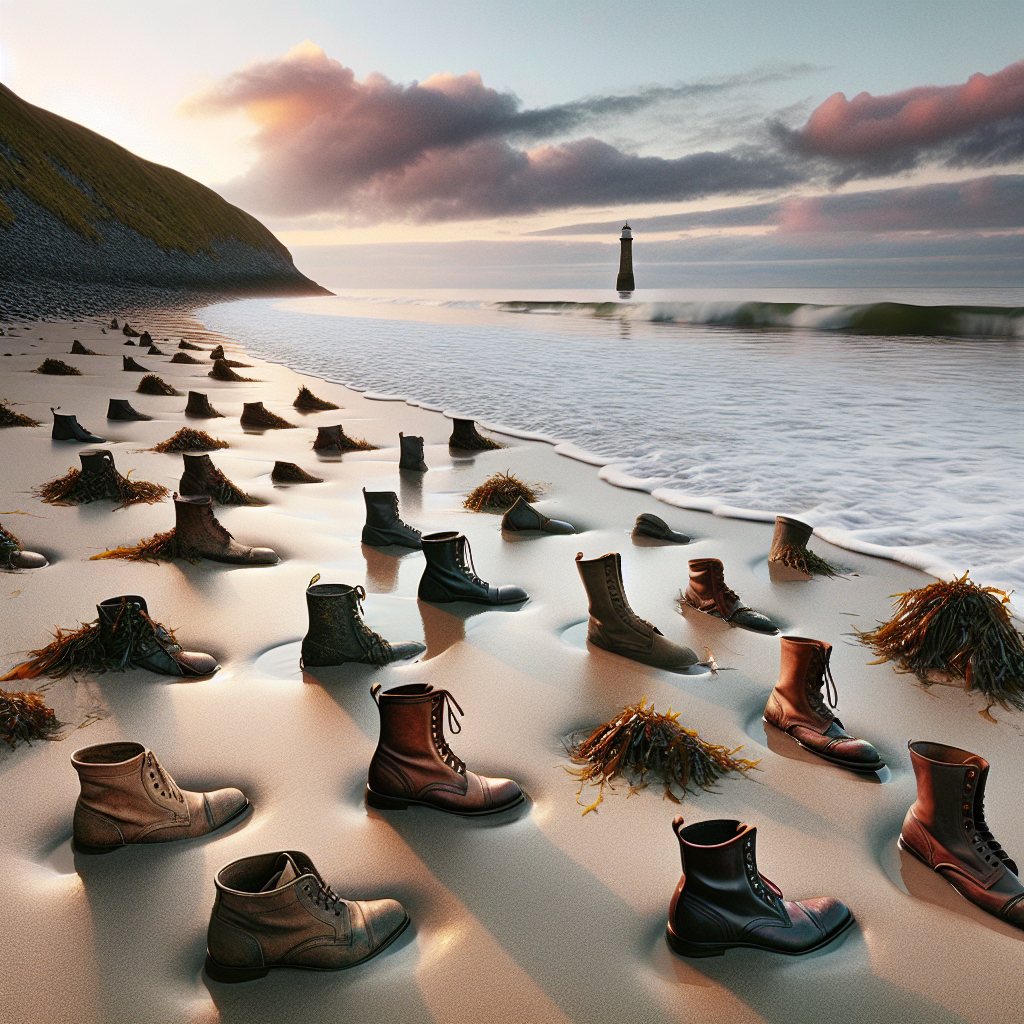
# Mystery as Hundreds of Victorian Shoes Wash Up on Beach
Imagine strolling along a serene Welsh beach, only to stumble upon hundreds of antique leather boots emerging from the tide like relics from a bygone era. That’s exactly what happened recently at **Ogmore By Sea Beach**, where volunteers uncovered over 400 **Victorian-era hobnailed boots** while cleaning rock pools.[1][2] These black leather treasures, dating back to the 19th century, have sparked a tantalizing mystery that’s captivating historians, archaeologists, and beachgoers alike.
## The Astonishing Discovery
The finds began during a routine beach cleanup organized by local volunteers at Ogmore By Sea, a picturesque stretch along the Bristol Channel in Wales. What started as a hunt for plastic waste turned into an archaeological bonanza. Tucked among the rocks and seaweed were **hundreds of well-preserved black leather boots**, many featuring distinctive hobnails—small metal studs embedded in the soles for traction on rough terrain.[2]
Eyewitnesses described the scene as surreal: boots of various sizes, some still intact with laces or stitching visible, washing ashore after storms churned up the seabed. “It was like stepping into a time capsule,” one volunteer recounted in early reports. Over 400 pairs (or singles) have been documented so far, with more potentially still hidden beneath the waves.[1][2] The boots’ condition is remarkable, preserved by the cold, salty waters that act as a natural preservative for leather goods.
Ogmore By Sea isn’t new to oddities—its dramatic cliffs and tidal pools often yield shipwreck debris—but this haul stands out for its volume and uniformity. All appear to be men’s work boots from the Victorian period (1837-1901), a time when hobnailing was common among laborers, miners, and sailors.[1]
## What Makes These Boots Victorian?
Victorian footwear was built to last, reflecting the industrial grit of 19th-century Britain. **Hobnailed boots** were everyday gear for the working class, with iron nails hammered into the soles to prevent wear on cobblestones, factory floors, or muddy fields. These weren’t dainty dress shoes; they were rugged, ankle-high designs crafted from thick leather, often oiled for waterproofing.[2]
Experts dating the boots point to stylistic clues: straight-laced fronts, sturdy stitching, and the absence of modern synthetic materials. Radiocarbon testing or closer metallurgical analysis could pinpoint exact ages, but initial assessments confirm a 19th-century origin. Their presence en masse suggests a catastrophic event rather than random drift—perhaps a ship laden with cargo that met its end offshore.[1]
## Theories Behind the Beach Invasion
So, how did **hundreds of identical Victorian boots** end up on a modern beach? Several compelling theories have emerged:
– **Shipwreck Salvage**: The Bristol Channel is a graveyard of wrecks, with over 2,000 recorded losses since the 1700s. A coal ship or merchant vessel carrying boots as cargo could have sunk during a fierce storm, dislodging its load over time. Storms in recent weeks may have finally unearthed them from sandy graves.[1]
– **Industrial Dump**: Victorian factories produced boots in bulk, and waste disposal was lax. Could these be refuse from nearby leatherworks, carried by rivers into the sea? Ogmore’s proximity to industrial heartlands like Cardiff supports this, though the sheer number leans against casual dumping.[2]
– **Smuggling or Hoard**: Less likely but intriguing—smugglers hiding contraband footwear? Or a lost baggage from a passenger ship? Historians note similar “shoe beaches” elsewhere, like Canada’s 1990s trainer spill, but those were synthetic and modern.
Local archaeologists urge caution: “Marine currents can transport artifacts vast distances,” warns one expert. DNA or maker’s marks on the leather might reveal origins, but erosion is already claiming some specimens.[1][2]
| Theory | Likelihood | Supporting Evidence |
|——–|————|———————-|
| **Shipwreck** | High | High wreck density in Bristol Channel; uniform boot style suggests cargo[1] |
| **Industrial Waste** | Medium | Victorian manufacturing hubs nearby; leather preservation in water[2] |
| **Smuggling** | Low | No historical records; too many for covert operation |
| **Natural Drift** | Low | Volume too great for scattered losses |
## Historical Context: Victorian Life in Leather and Nail
To appreciate the mystery, consider the boots’ era. Victorian Britain was the workshop of the world, with bootmakers in places like Northampton churning out millions annually. Hobnails weren’t just functional—they echoed military surplus from the Napoleonic Wars, repurposed for civilians. A single pair might cost a week’s wages for a miner, making their loss monumental.[1]
These boots whisper stories of toil: Welsh coal pits, ironworks, or seafaring voyages. Ogmore By Sea, with its ancient castle ruins, was a hub for smuggling and trade, amplifying the wreck theory. Climate change and intensified storms could be resurfacing long-buried relics, a reminder of how the past literally washes up on our shores.
## Preservation Efforts and Public Fascination
Volunteers aren’t just collectors—they’re preserving history. Boots are being cataloged, photographed, and stored in climate-controlled conditions to prevent mold. Calls for professional excavation grow, with hopes of museum displays. Social media buzzes with #VictorianShoes, drawing tourists to Ogmore for “boot hunts.”
This event underscores beaches as time capsules. Similar hauls include 19th-century pottery from Australian shores or Roman coins in the UK. As sea levels rise, expect more such unveilings.
## Why It Matters Today
Beyond intrigue, the discovery highlights ocean cleanup’s unexpected rewards. What began as plastic patrol unearthed heritage, proving environmental stewardship uncovers history. It also prompts reflection: how will our disposable plastics fare in 150 years?
As experts investigate, Ogmore’s boots remain a poignant mystery—ghosts of Victorian grit riding the waves into 2025. Will DNA traces or wreck logs solve it? For now, they invite us to ponder the sea’s secrets.
(Word count: 812)
Original source: BBC News – Mystery as hundreds of Victorian shoes wash up on beach