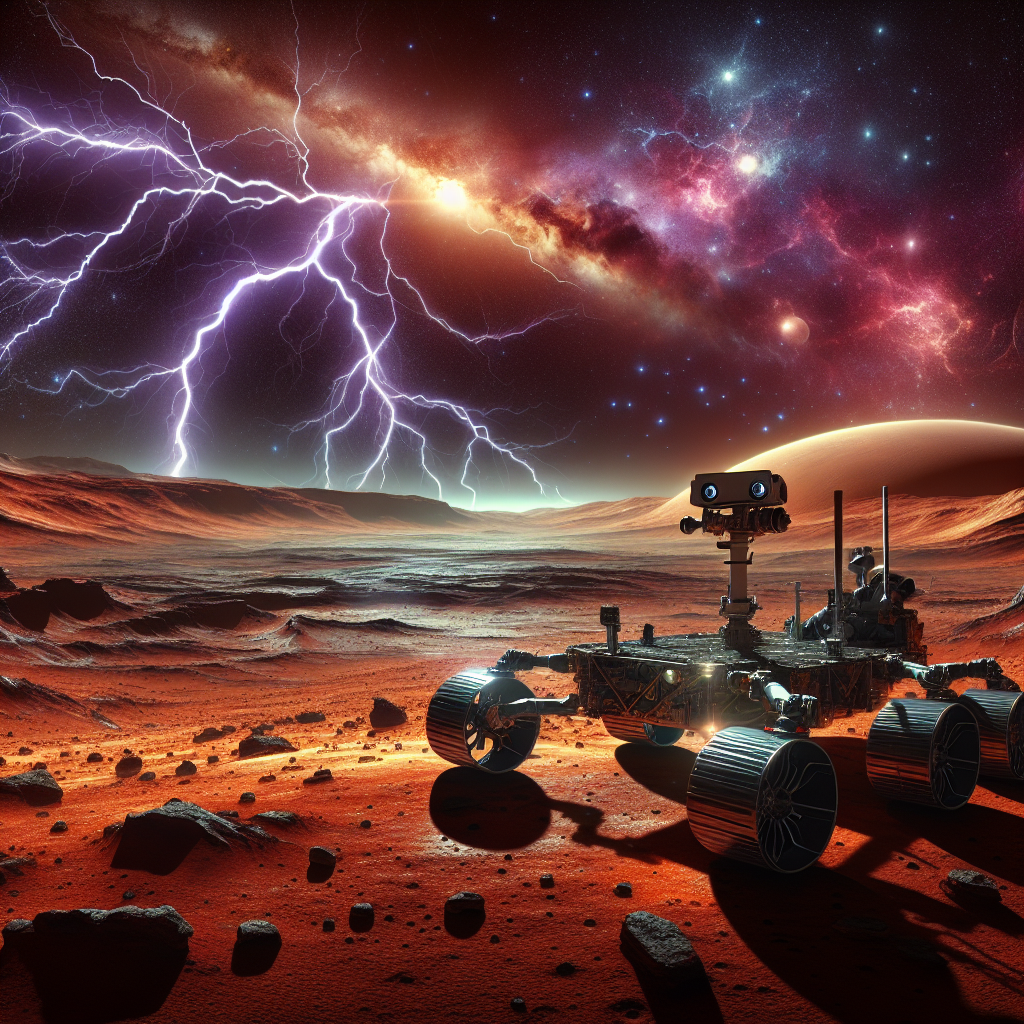
# At Long Last, the Mystery of Lightning on Mars is Solved
For decades, scientists have wondered whether lightning exists in the Martian atmosphere. Now, thanks to an unexpected discovery by NASA’s Perseverance rover, researchers have finally confirmed what theorists have long suspected: Mars does indeed have lightning.[1][2] This groundbreaking finding, reported in the journal *Nature*, represents a major milestone in our understanding of the Red Planet’s atmospheric dynamics and could have significant implications for future missions to Mars.
## The Accidental Discovery
The confirmation of Martian lightning came through a fortunate accident. Scientists analyzing audio recordings captured by the Perseverance rover’s microphone detected crackling sounds that matched the acoustic signature of electrical discharges.[1][2] The rover, which has been exploring a dry river delta on Mars since 2021, was equipped with a microphone primarily designed to record the sounds of the rover’s laser system examining Martian rocks. Instead, it captured something far more significant: the telltale sounds of “mini lightning” occurring within just a few meters of the rover’s mast.[1]
The discovery was made by a French-led research team, with Baptiste Chide from the Institute for Research in Astrophysics and Planetology in Toulouse playing a key role in identifying and analyzing the signals.[1] After hearing a presentation on atmospheric electricity at a science conference, Chide realized that the crackling sounds previously dismissed as noise from dust and sand grains could actually be electrical discharges. He conducted experiments on Earth using an electrostatic generator to confirm that the distinctive pattern of electrical interference followed by acoustic shockwaves matched what had been recorded on Mars.[2]
## The Nature of Martian Lightning
The electrical arcs detected on Mars are quite different from the dramatic lightning bolts we experience on Earth. Researchers documented 55 instances of what they call “mini lightning” over two Martian years, with the electrical arcs measuring just inches or centimeters in size.[1] These tiny sparks are similar to the static electricity we generate when touching a doorknob on a dry day, rather than the powerful bolts that illuminate Earth’s skies.[2]
The Martian lightning events were primarily associated with dust storms and dust devils—the whirling vortices that frequently sweep across the planet’s surface.[1] The electrical discharges generated by fast-moving dust devils lasted only a few seconds, while those spawned by larger dust storms could linger for as long as 30 minutes.[1] Almost all of the recorded events occurred on the windiest Martian sols, or days, during these atmospheric disturbances.[1]
## Why Mars Has Lightning
The underlying mechanism behind Martian lightning involves the friction between dust and sand particles in the planet’s thin, carbon dioxide-rich atmosphere. When researchers conducted laboratory experiments in the 1970s, they pumped volcanic sand into flasks at Martian atmospheric pressures and swirled the sand, observing a glow visible in the dark.[2][3] This glow resulted from electrical charges created by friction between sand grains. With sufficient buildup of electric charge, these conditions could produce sudden discharges similar to spark plugs in car engines or, on a larger scale, lightning.[2][3]
Mars’ atmosphere is inherently more prone to electrical discharging and sparking through contact among dust and sand grains than Earth’s atmosphere.[1] As planetary scientist Ralph Lorenz from Johns Hopkins University Applied Physics Laboratory notes, there is no reason why blowing dust or sand on Mars shouldn’t become electrically charged, especially since lightning can occur on Earth within turbulent clouds of volcanic ash.[2]
## Implications for Future Missions
While the discovery of Martian lightning is scientifically fascinating, it also raises practical concerns for future exploration. The evidence suggests that an astronaut walking on Mars would be extremely unlikely to be struck by a direct lightning bolt, as the electrical discharges are small and the thin atmosphere makes them barely visible in the bright Martian daylight.[1] However, the frequent small static-like discharges could potentially prove problematic for sensitive electronic equipment used by robotic or human missions.[1]
This concern is not merely theoretical. The Soviet Mars 3 mission landed during a dust storm in 1971 and operated for only about 20 seconds before mysteriously ending its transmission.[2] While the cause remains unknown, researchers cannot rule out the possibility that an electrical discharge event may have damaged the spacecraft’s systems.[2]
## A Missing Puzzle Piece
For the scientific community, this discovery represents far more than just confirmation of a suspected phenomenon. According to Chide, finding lightning on Mars “opens a completely new field of investigation for Mars science” and is “like finding a missing piece of the puzzle.”[1] The electrical discharges could have significant chemical effects on the Martian atmosphere that scientists are only beginning to explore.
While some researchers note that the findings are based on a single instrument not specifically designed to detect lightning, and that the discharges were heard rather than seen, the evidence is compelling and consistent with theoretical predictions.[1] As Mars exploration continues, scientists emphasize the importance of studying this atmospheric electrical activity to better understand the hazards it could pose to future missions and to unlock the secrets of Martian atmospheric chemistry.
The mystery that has intrigued planetary scientists for half a century has finally been solved, thanks to an unexpected audio recording from a rover exploring an ancient riverbed on the Red Planet.
Original source: NPR News – At long last, the mystery of lightning on Mars is solved