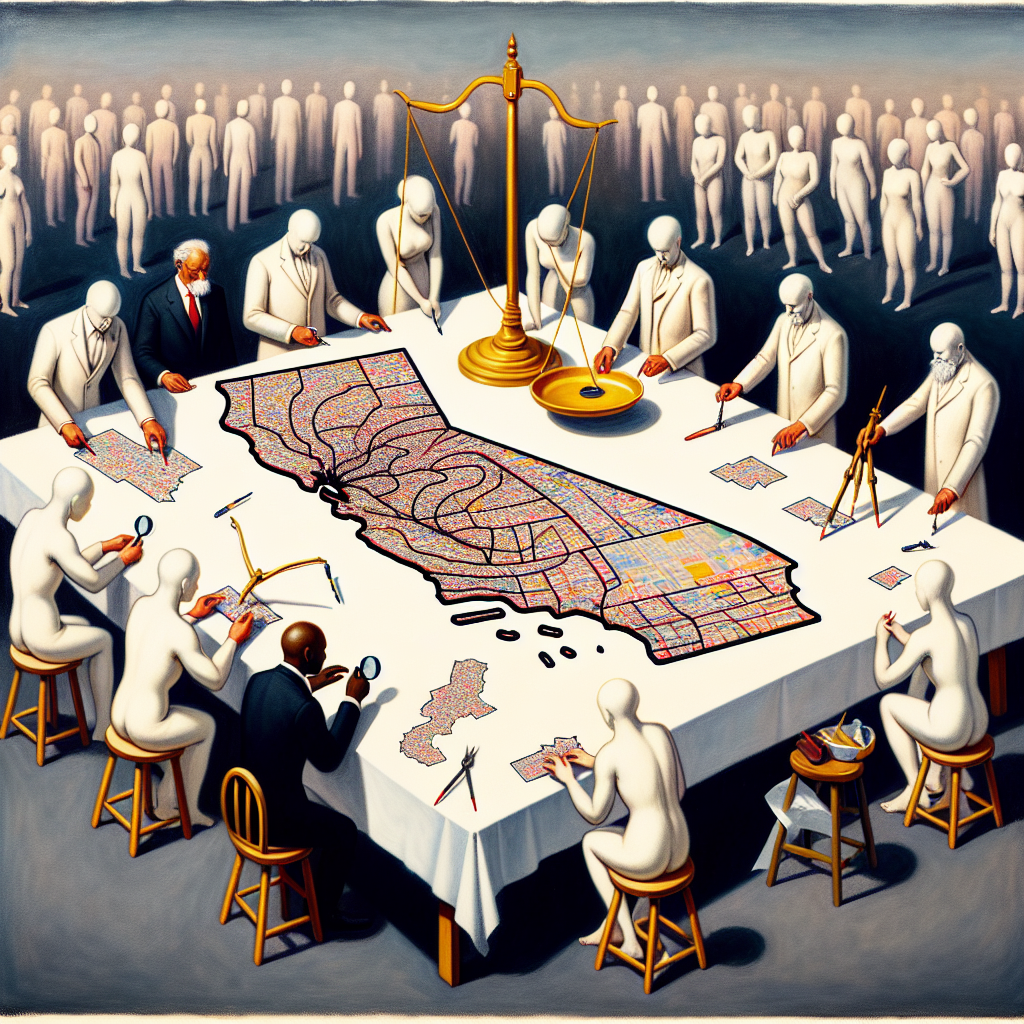
California’s recent vote on **Proposition 50** marks a pivotal moment in the national redistricting battle, directly countering Republican-driven changes championed by former President Trump and Texas lawmakers. As of November 2025, California’s redistricting landscape has shifted, with new district lines set to reshape both state and national politics[1][4][5].
—
**California’s Response to the Trump-Texas Redistricting Push**
The origins of Proposition 50 lie in Republican efforts—led by Trump and Texas officials—to redraw congressional boundaries in ways that netted them five additional seats in the U.S. House of Representatives. California Democrats viewed this as a direct threat to representative fairness and responded with their own redistricting initiative. Proposition 50 proposes new boundaries for many of California’s 52 congressional districts, aiming to negate the advantage Republicans gained and potentially flip up to five seats back to Democrats[1][4].
**Key Provisions of Proposition 50**
– **Leveling the Playing Field:** The measure ensures that the 2026 mid-term elections are conducted under maps that do not unfairly favor Republicans, directly counteracting the Texas-led redistricting changes.
– **Fair and Proportional Mapping:** Proposition 50 provides emergency congressional maps only as a direct response to the Republican power grab. These maps are designed to remain temporary, expiring in 2030, after which California’s independent redistricting reforms will resume their usual process[1].
– **Voter Empowerment:** Perhaps most notably, Prop 50 returns significant power to the voters, allowing them to approve emergency district maps instead of leaving decisions to political insiders. This approach is designed to increase transparency and public trust in the process[1].
– **Commitment to Independent Redistricting:** While the emergency maps override California’s standard procedures, Prop 50 reaffirms the authority of the California Citizens Redistricting Commission to draw districts after the next census, preserving the state’s reputation for fair and nonpartisan mapping[1].
**Election Results and Immediate Impact**
According to official results, Proposition 50 passed decisively on November 4, 2025[3]. The measure’s approval means that California will begin using the new, legislatively drawn congressional maps starting with the 2026 elections[5]. This is expected to shift the balance of power in the state’s congressional delegation, possibly giving Democrats up to five additional seats and tilting the House of Representatives away from the Republican majority achieved through the Texas redistricting initiative[4].
**Winners, Losers, and Political Fallout**
The passage of Proposition 50 is a clear victory for California Democrats and national progressives, as highlighted by POLITICO’s analysis of the “redistricting war”[4]. It represents a forceful rejection of Trump-era gerrymandering tactics and sets a precedent for other states considering similar countermeasures.
– **Winners:** California Democrats, national Democratic leadership, and advocates for independent redistricting.
– **Losers:** Republicans who benefited from the Texas-led power grab, as well as those who support partisan redistricting.
The measure also has national implications. By showing that states can mobilize quickly to counteract perceived election manipulation, California has set a template for legislative and legal resistance to partisan gerrymandering.
**Temporary Shift and Future Uncertainties**
It’s crucial to note that the emergency maps introduced by Proposition 50 are **temporary**, set to expire in 2030[1]. After that, the California Citizens Redistricting Commission will once again take the lead, using data from the next census to redraw districts through its established, award-winning process. This sunset clause is intended to reassure voters that Prop 50 is a tactical, not permanent, deviation from California’s commitment to independent and impartial redistricting[1].
**Redistricting Nationwide: The Broader Landscape**
California’s actions are part of a larger, ongoing national debate over redistricting fairness, gerrymandering, and the role of state and federal governments in shaping electoral maps. While Proposition 50 specifically addresses the emergency created by Republican maneuvers, it also calls for a “nationwide commitment to fair and impartial maps,” signaling California’s continued leadership in electoral reform[1].
As of November 2025, redistricting remains a patchwork across the country. Some states have embraced independent commissions, while others continue to use legislatively controlled processes susceptible to partisan influence. The events in California may inspire similar emergency measures in other Democratic strongholds, especially if partisan gerrymandering intensifies in swing states.
**Looking Ahead: What to Watch for in 2026 and Beyond**
– The practical effects of the new district maps will become clear in the 2026 mid-term elections, potentially shifting control of the House of Representatives.
– Legal challenges may arise, testing the durability of Proposition 50 and the emergency redistricting process in federal courts.
– The expiration of Prop 50’s maps in 2030 will return the process to the California Citizens Redistricting Commission, restoring the state’s independent approach.
– National debates over the future of redistricting—whether reforms or countermeasures like California’s gain traction—will continue as both parties seek to secure electoral advantages.
—
In summary, California’s vote to counter Trump’s redistricting efforts has fundamentally altered the state’s congressional landscape and set a new standard for rapid, voter-driven resistance to partisan mapmaking. With new emergency maps in place and a renewed commitment to fairness, California’s actions will shape both state and national politics for years to come[1][4][5].
Original source: NPR News – After California’s vote to counter Trump, here’s where redistricting stands